Christopher Nolan has never been shy about bringing familiar faces back into his cinematic universe. In The Odyssey, two of his former collaborators answer the call once more: Elliot Page, 16 years after bending reality in Inception, and Himesh Patel, reuniting with the director following Tenet. This time, spinning tops and turnstiles give way to ancient mythology, elaborate prosthetics, practical effects and performances that cut straight to the bone.
As The Odyssey arrives on Digital, 4K Ultra HD and Blu-ray, the two actors sat down with Complex Canada to discuss the making of one of the year’s biggest cinematic spectacles.
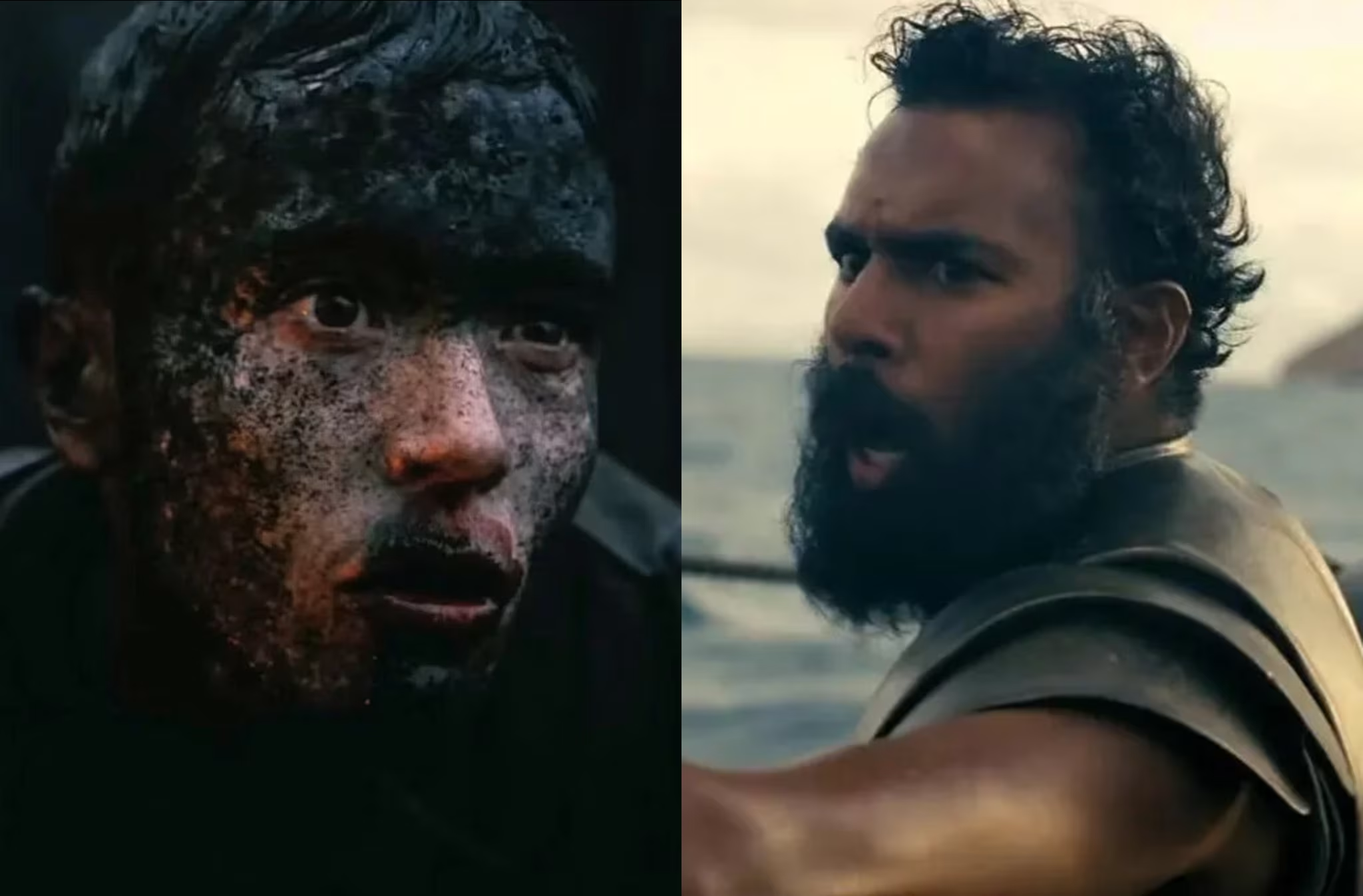
Page plays Sinon in a scene-stealing performance that haunts the film long after he leaves the screen, echoing all the way into the underworld of Hades. When Nolan first approached Page about the role, their conversation centred on the psychological toll of survival.
"I guess our first conversation was about this character on some level representing Odysseus's conscience and confronting him in this moment, and the impacts and the consequences and the devastation of war and violence and sacrifice," Page says. From there, the mission was clear, if daunting: "The focus for me was just hopefully getting that scene right and being able to convey just the degree of the feelings of betrayal and disappointment and just profound regret."
If Page’s journey through the film is one of devastating reckoning, Patel’s is one of physical endurance and, occasionally, hilariously grotesque chaos. As Eurylochus, Patel is at the centre of one of the film’s most talked-about set pieces: the Circe sequence, where Odysseus’s men are transformed into pigs. Nolan leaned into old-school horror and practical effects rather than relying on CGI, a choice that caught Patel delightfully off guard.
"It was just surreal, really. I hadn't met any of that stuff until I got there on the day," Patel laughs, noting that aside from knowing he had a prosthetic for his ear, he walked onto set unaware of the full spectacle. "A couple of the other guys turned up in full prosthetics, which was hilarious."
Playing opposite Samantha Morton in the buildup to the transformation was a thrill, he says, and watching the technical machinery of the scene come alive was something else entirely. "It was fascinating to see how what had been planned and how it was being achieved was just amazing to watch, with broth all over my beard and my face is a complete mess, but I kind of love that," Patel recalls. "It's a moment of such extremes. It was just like we're all just eight guys sort of screaming at each other with our eyes while we can't stop eating. It was just really funny. They call cut, and I'd just be like, 'This is so funny.'"
The sequence also made use of animatronic pig masks, a reminder of just how effective traditional filmmaking techniques can be. "In came the animatronics, and that was just surreal and mind-blowing to see that stuff working and to know that it's stuff that's been around for decades and decades, and we just sort of lost sight of its power in the world of CGI but it's so powerful."
For Page, The Odyssey carried a deeply personal resonance, marked by both grief and gratitude. Nearly 16 years after Inception, a film that reshaped modern blockbuster cinema, he found himself back in Nolan’s orbit, at a very different point in his life.
"I guess a feeling would be gratitude that I continue to get to do this work, and to be able to look back to a film like Inception and be able to be here now and a part of this," Page reflects. "I'm so grateful to Chris for asking me to come back, and I think especially just now in my life being in a much different place than I was when I shot Inception, it was just such a joy to get to be on a Nolan set with how I feel now."
When production finally wrapped, the emotional weight of that 16-year journey hit all at once. "One thing I felt when I wrapped on this was actually very emotional, and I think that related to the full-circle nature, how I felt before, how I get to feel now," Page shares. "I think maybe there was a bit of grief I was letting go in that crying [scene], and also a feeling of gratitude to be where I'm at now. I left feeling like I could do some of my best work now. There was something about that experience that was very important and crucial for me. It made me maybe feel more confident in where I'm at right now."
For Patel, spending six months alongside the cast and crew offered a different kind of personal discovery. Asked what tested his mettle, he doesn't hesitate: "Every step of the way, really. I would say a lot of the physical stuff tested me and reminded me that I maybe need to be in better shape just to be ready for those things in the future,” he says with a laugh.
Yet, even during the film’s most physically demanding moments, including gruelling water sequences that Patel jokingly describes as "almost being drowned,” he found himself “realizing my own resilience and just how much I love it."
"Actually, I wasn't really scared. I wasn't really worried. I was excited, and that was just a real reminder that I love doing this, and I feel so lucky to be doing it."
That realization also stripped away some of the mythology surrounding Hollywood itself. Watching Nolan and star Matt Damon work day in and day out gave Patel a grounded perspective on the craft and what it takes to succeed.
"You realize that it's all about hard work. Chris is just always working hard. Matt's just always working hard, and they love what they do. They love being part of the business. They worked at it and that's what it is," Patel says. "We're often fed an illusion of what success is, or how to get success, what you need to be to be successful, but ultimately, you just got to work hard."
Spending months on a production of this magnitude also gave both actors a greater appreciation for Nolan’s approach to filmmaking. For Patel, what sets the director apart is his relentless ambition and attention to detail.
"I think it is that constant sort of ambition, and in a way it has to be at times defiant," Patel says, quickly clarifying that Nolan is never reckless with safety. "He's also so knowledgeable about so many different things when it comes to making films, but also in general, that he can engage with anyone on any subject, and in a way, if he needs to, fight his corner for what he wants to achieve. That's what makes it so exciting, because he really cares about every single moment in his movie, and any moment he's trying to capture. However it ends up in the end, he wants every moment to be truthful and to aim high at all times."
Page, meanwhile, points to a quality that might surprise those who know Nolan as one of cinema’s most meticulous filmmakers: his instinct for the unplanned.
"I'm actually thinking of the first day, the first thing I shot," Page says. On the eve of principal photography, they walked down to the sand dunes with the casual intention of running a few camera tests. "Chris was like, 'But maybe we'll just shoot' – which is very Chris, the day before you're supposed to make this massive film, and you're almost casually like, 'Yeah, but we might.'"
That impromptu moment ultimately made the final cut. "It's me sitting on the dune and drinking the water at the beginning, that was the very first thing shot," Page says with a smile. "I think it's that sort of spontaneity, fluidity—dare I say, playfulness too—in the sense that, of course, it's something that needs to be meticulously planned out, or a big stunt sequence, or what have you. But actually, there's this very organic, kind of fluid quality. That juxtaposition with Chris is something that's really special, and I feel like that moment defines that for me."
In the end, that balance between meticulous planning and creative spontaneity is central to The Odyssey. The first feature film shot entirely on IMAX film cameras, Nolan’s adaptation brings together the scale of ancient mythology, the ambition of large-format filmmaking and the deeply human performances of the actors tasked with bringing it all to life.
The Odyssey is now available on Digital, 4K Ultra HD and Blu-ray, giving audiences an opportunity to go behind the scenes of Nolan’s most ambitious productions to date. Personally overseen by Nolan, the home entertainment release includes more than 90 minutes of exclusive bonus content, including 12 behind-the-scenes featurettes exploring the construction of Troy, the creation of the Cyclops and the collaboration between the visual and special effects teams. It also includes the music video for “When I’m Home” from James Blake, Travis Scott and Ludwig Göransson.