Key Takeaways
- Concordia professor and veteran rapper Yassin “Narcy” Alsalman’s course Drake: Media, Myth, and Manhood uses Drake’s catalog to examine Canadian identity, celebrity, hyper-masculinity, politics, and corporate power.
- Alsalman argues that Drake reflects Canada’s multicultural hybridity and plans to bring in guests including Majid Jordan, with producer Noah “40” Shebib also invited to discuss the music firsthand.
- The course frames Drake and Kendrick Lamar’s battle as an “attempted character assassination” and asks students to scrutinize celebrity responsibility, industry incentives, and the political systems surrounding pop culture.
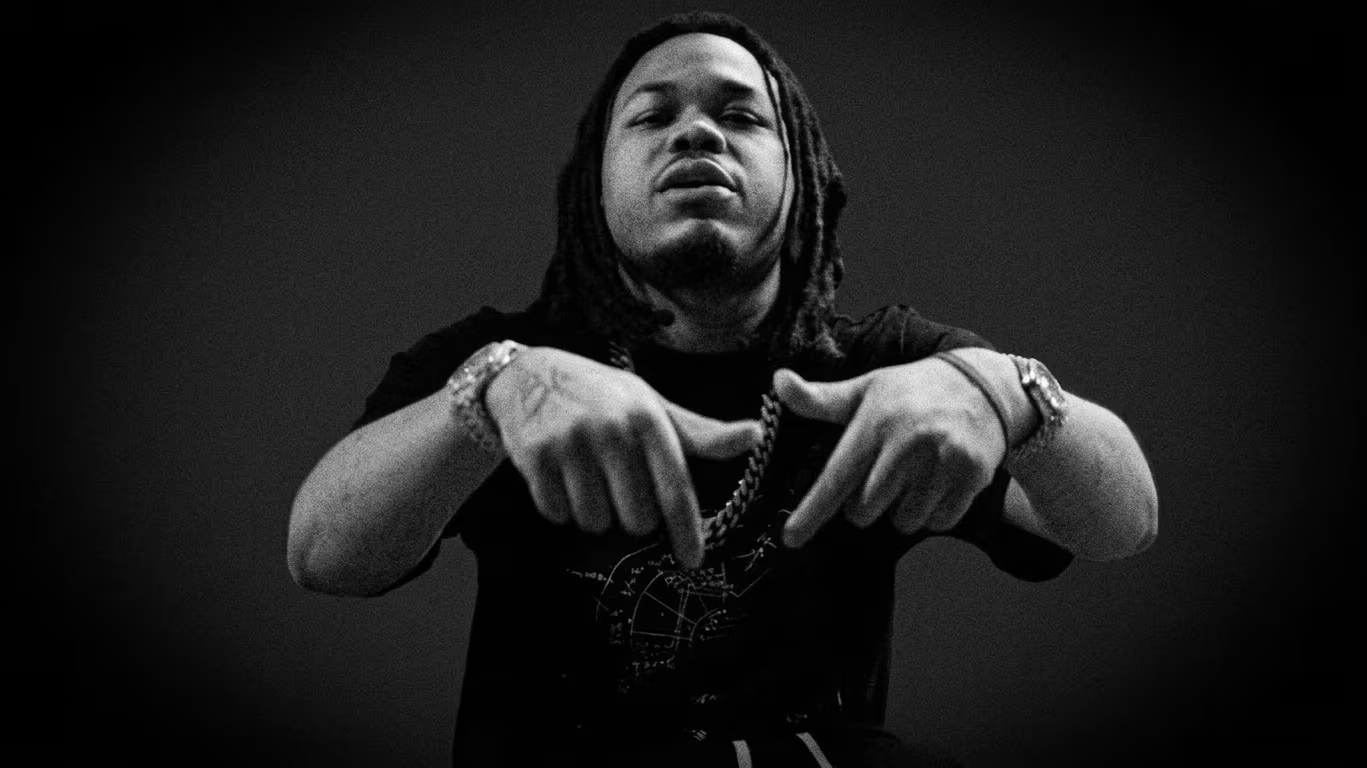
Yassin “Narcy” Alsalman is a veteran rapper and writer who has collaborated with everyone from Yasiin Bey and Talib Kweli to Todd Rundgren and Yo-Yo Ma. But the Iraqi-Canadian has been best known over the past few years for the college courses he teaches at Concordia University in Montreal that center important figures in hip-hop and popular culture.
The classes started in 2022 with one on Kanye West (the timing, as you’ll see, proved challenging), before moving on to Kendrick Lamar, Dave Chappelle, and Spike Lee.
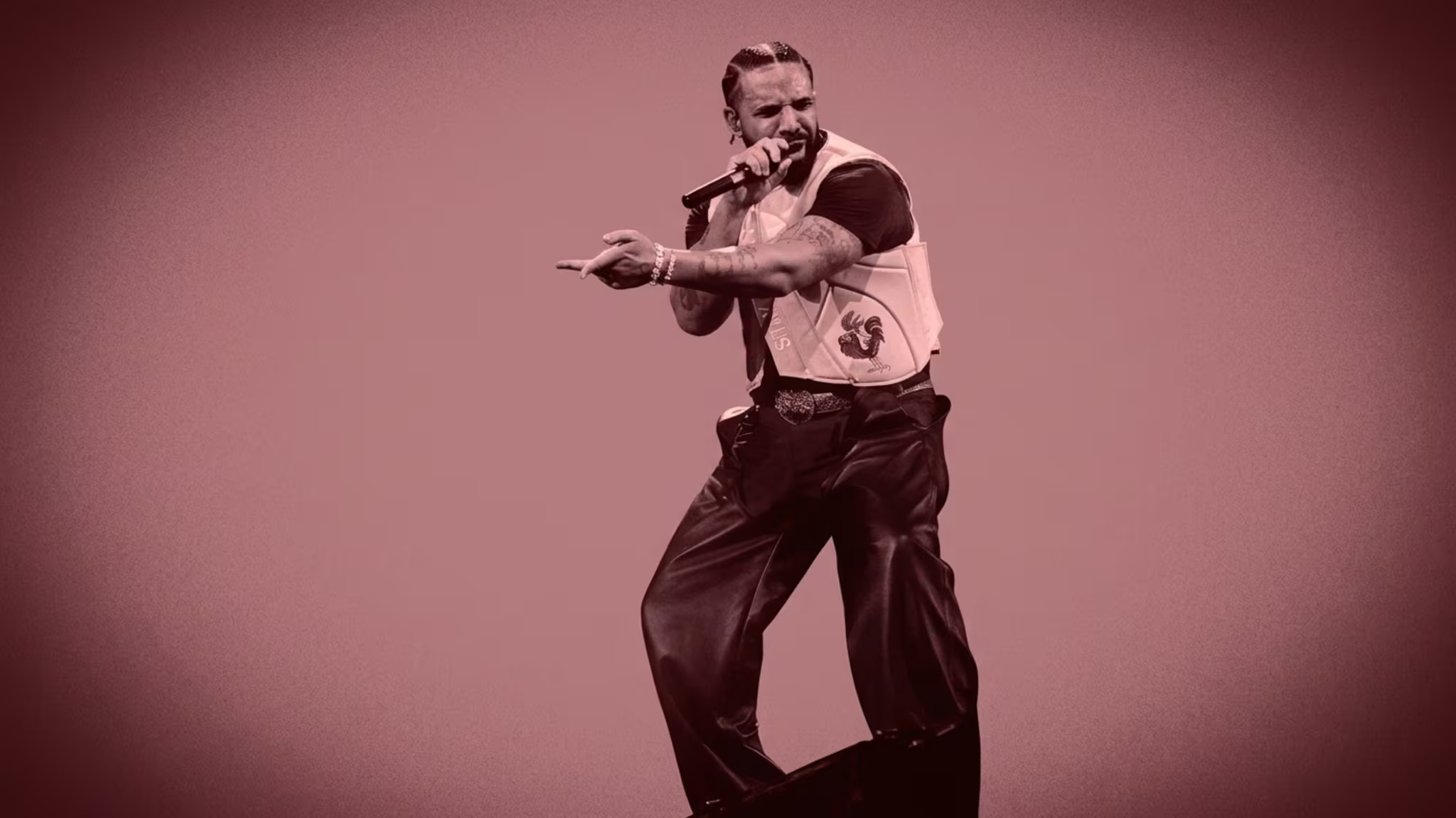
Now, Alsalman is taking on his home country’s biggest export: Drake. This fall, Drake: Media, Myth, and Manhood is guiding students through Drizzy’s entire catalog, while engaging with all of the social issues inherent in the superstar’s rise.
As with his other classes, the professor is tapping into his years in hip-hop in order to line up an array of special guests—and in this case, a friendship with Drake’s main producer, Noah “40” Shebib, means that those guests are likely to be good ones.
We called up Alsalman to talk about his class, the Drake and Kendrick battle, and what it was like to teach about Kanye while he’s in the middle of blowing up his career.
This interview has been edited for length and clarity.
This isn’t the first class you’ve taught that centers on a big pop culture figure. How did this start for you?
After the pandemic, I started shaping my syllabus in response to whatever was going on in the zeitgeist of hip-hop at the time, which started with a class on Ye. It was called Kanye Versus Ye: Genius by Design. About three weeks into that, Kanye went “death con three” on Twitter.
Then I had to move away from him because as a pro-Palestinian artist and professor in the university, it became very hard for me to navigate the narrative that was being presented and that he was really pressing on. So I moved on to do classes on Kendrick, and then I did one on Dave Chappelle, which was more about the community of Soulquarians and that ethos. Then I did a class on Spike Lee's films.
The last two years of witnessing the genocide really influenced the content of the class. I couldn't help but draw parallels between what we were witnessing in the sense of empire and this cultural shift that was occurring around celebrity art and creativity and America versus Canada—all these conversations that were being had on a political level—and how it was intrinsically tied into this idea of Drake. I wanted to start discussing this specific point in his career—going towards independence and what that means to be that big and challenge a corporate system that seems to have its foot on your neck.
I want to go back to the Ye class. Like you said, a few weeks into the class, his antisemitic “death con three” tweet happens. Take me through that.
I had all these guests lined up. I was talking to Jason [Lee] from Hollywood Unlocked, who was doing all Kanye’s press and online stuff. He was going to join us in class four. That was the goal. I had Coodie Rock the second week, after we watched the Jeen-Yuhs documentary [that he co-directed], and then I had A-Trak join us to talk about the Glow in the Dark Tour and grief and him losing his mom and stuff. Then we had a class on Black Star and the beginnings of Ye.
That Friday, after my third class, he put out the tweet. And in true Ye fashion, the class became this free-form, changing class. I had to really address what was going on, because every week something new was happening. He was in the midst of tearing down the old Kanye and becoming Ye, and unleashing all of the corporate ties that he had. So every week, we watched stuff that was happening online and discussed it.
I ended up getting doxxed. The newspaper here wrote an article about how I wasn't doing enough about addressing antisemitism in class. It was like I was part of [Kanye’s] team all of a sudden.
I had to address that in class. There were some security threats. So much happened. It was an amazing experience for me as a professor. I'm a huge Kanye fan. I grew up listening to the music, and I love the fashion and everything.
It was a learning curve on how to write a syllabus around an artist that's living. Most of the time, people teach classes about artists that have passed already. Since then, I have shaped my syllabus around artists that people are consuming, to speak about the responsibility of the consumer as much as the responsibility of the artist.
With this Drake class, do you touch on the strictly musical aspects of his output?
We have one class where we are talking about song production, with Majid Jordan joining us to talk Nothing Was the Same and when they wrote “Hold On, We’re Going Home.” And I'm hoping to have 40 join me at some point. I don't know if he will. I've asked him.
You mentioned Gaza and the genocide in your first answer. 40 has been extremely outspoken about that. Drake, I don't believe, has made any statements publicly aside from a few lyrics, signed the Artists4Ceasefire letter. So I guess my question is, what role will the Gaza genocide play in your class, and to what extent does that connect, if any, to Drake's musical output?
I interviewed 40 for Rolling Stone Middle East. It was maybe eight months after they signed the ceasefire letter. So in there, we talk about—and this is not official—but what the ramifications of signing that ceasefire letter had to do with everything that occurred afterwards. For me as a viewer and consumer and believer in the art, I immediately saw a connection between their stance and what occurred to them.
We're going to be discussing that connection of artists making political statements outside of their work. Because Drake is not a political artist by any means. His work is very much a distraction from the real world, if you will.
I do definitely see lines between this moment in history and what is occurring in the music industry, and a very clear line as to who stands where when it comes to this issue.
One thing that you and Drake have in common is that you both exist in a space between multiple identities. With Drake, his identities are Canadian and American, rapper and singer, Black and white. You moved between the East and West growing up, and are both Iraqi and Canadian. How does this idea of multiple identities connect you to Drake, and how will it come into the course?
Hybridity is a big part of the Canadian experience. Culture is very different in Canada than it is America—this is culture as an overarching concept. Although we share very common cultural experiences because we are on the same continent, when you're in New York, it feels like everybody is on top of each other and there are no lines.
But the conversation around race and culture in America is very different than it is in Canada, because of the history of race in America and in Canada. If you're talking about the Black experience of America, it is very different than the Black experience of Canada. But that doesn't take away from the Canadian Black experience. If you look into our history, there is a very strong form of prejudice. And at the end of the day, both these countries were built on the replacement of an indigenous culture with a new one.
In Canada, the idea of hybridity is very present in our cities. I live in Montreal, which is within a province that has an identity crisis around belonging in Canada. You don't feel that on a day to day level when you live in the city, but the system and the conversation that it's having with itself always brings this up.
As Canadians, we relate to Drake because he reflects…people call this “culture vulturing” or they call it “appropriation,” but when you walk around Toronto and you cross from one area to the next, you are encountering cultures in a very rich and and beautiful way. The segregation is only through street signs, not through cultural experience.
The linguistic exchange that we have on the streets here, it incorporates Arabic words. It incorporates words from the islands. It incorporates so many cultural references at once. Somebody will say, “wagwan” [Jamaican slang for “What’s going on?”] in the same sentence that they say “wallahi” [Arabic for “I swear to God”]. That experience and that Canadian identity is what links a lot of us to Drake, and he becomes sort of an ambassador for the country. Not that he's a perfect representative of everybody. He's a billionaire, so there's things I can't relate to. But culturally speaking, he represents what Canada feels like.
In the syllabus for the class, you mention patriarchy. Drake has received a lot of criticism for his association with some manosphere-adjacent streamers, for his lyrics appearing to mock Megan Thee Stallion, and for this overarching idea that his attitude towards women doesn't reflect his age and stature. What are your thoughts about that?
What's most interesting for me with all the artists that I've covered in my classes, is that most of the time when we see these contradictions in an artist's work or personal life, they're very representative of the ones that we see in our lives and in our communities. I'm more interested in students being able to witness that and acknowledge it in an artist, and talking about how that's present in their life. So we are going to be discussing hyper-masculinity as opposed to patriarchy. Patriarchy is such a big problem and concept that you can't really tackle it in one session. We do a class on hyper-masculinity, and in that class we we ask the men in our class: What kind of internalized behavior do they have from the patriarchal system?
We read bell hooks books, The Right to Sex, all these different books to really start looking inward, through the artist. And we're obviously addressing how that reflects on Drake as a person and what he has presented as an artist.
When you talk about Drake’s beef with Kendrick Lamar in the syllabus, you call it an “attempted character assassination.” I was really struck by that wording, and I was hoping you could expand on that.
I grew up in the Tupac era, so I was my students’ age or a bit younger when Pac and Big went at each other. Then there was Nas and Jay. Those are the two major beefs that I've experienced in commercial hip hop.
In those beefs, it was never taken to a place where that person's character was in question. It was personal. They kept it very personal—which was gross, if you're talking about the things that Jay said about Nas on “Takeover” and “Super Ugly.” They were gross things, but they were personal. They weren't accusations that require a legal framework.
Calling somebody a [pedophile] at a time when the Epstein files were such a public discussion, while we're watching the massacre of children and the sexualization of children, for a song that's a rap battle song to be platformed on one of the most gladiator-esque sports events in America against an artist, without any real, valid accusation or court case against that person—I view that as a bigger than what we've witnessed before. It's problematic. It almost props up empires’ subjugation of children within everything that we do.
So yeah, I did feel like it was a character assassination. I feel like it failed. If you look at it on a creative level, there's a judgment as to who won the the lyrical element. But if you look at the long term, I don't think anybody won. Even as consumers, we lost. The only people that really won were the executives sitting in the record label seats that made money off of both of them.
I'm interested in what you think.
I see it largely in the context of a rap battle, where this sort of hyperbole is standard. That's the context in which it was offered. And then, it being a hit song and being performed in the Super Bowl and all that, not that it was out of Kendrick's hands exactly, but you can't predict that sort of thing, right? The song comes from one context, and then got put in another by virtue of it being catchy. That's not something that can be planned for.
Yeah. At the end of the day, I'm a fan of music. I love the art. I love the culture so much that the investigation of this work is meant to demystify the things that trapped me within celebrity, but also to question everything.
I think with Ye, what I came to realize was he was a metaphor for the American empire and its contradictions. In a way, the problem with Ye was that he would love to be a subversive artist, but he's way too big to be subversive. You can't be subversive when you're talking to the mass, because you can't control who's listening to you.
What I'm trying to say is, with Ye, you can't be subversive on a pop level and try to use extremely problematic things, and expect the mass to understand that it's a subversive thing. So when he put the Confederate flag backwards on his jacket, he doesn't realize that people who look up to the Confederate flag are going to see that as support for their beliefs.
And I think when you're somebody like Kendrick, you're aware that your platform is way bigger than a rap battle. You're a pop artist. As much as hip-hop is at the core of his work, he's a pop artist. You can't be as irresponsible with the things that you promote at that level. This is ultimately the question in class: how can we accept celebrity without responsibility? That goes for Drake, that goes for Kendrick, that goes for Kanye, that goes for anybody.
I wanted to talk about your Chappelle class. There are multiple sides to him. There’s the side you focused on in the class, the community builder. And then there's this seeming bitterness that's creeped in in his recent performances, where he seems obsessed almost to the point of monomania about trans issues. How did you deal with that?
With the Dave class, what I was trying to focus on was this idea of kindness. The lesson that I learned from Dave is the idea of putting people into your space; and then the undoing of your career and the rebuilding of your career. That was the core of that class.
We definitely had the discussion about the controversy around Dave's jokes and the problematic nature of some of the things that he said. But again, what I try to do as a professor in these classes is bring up these issues and let the students have the conversation, and I just guide.
Listen, I know Dave personally. I don't believe in corporate and cultural cancel culture. I believe in holding people accountable for their actions and the wrongdoing that they've done to other people.
What's the difference between those two things?
I believe the public and social media version of cancel culture has been weaponized beyond its original form. When the #MeToo Movement began, or any movement for change and justice begins, it is outside the system. It belongs to the people and its power is pure and purpose is clear.
I believe that the insidious and duplicitous nature of our digital lives has infiltrated the social equity of its purpose and turned it into selective outrage. It’s a term I call BITCOINTELPRO, the systemized self-surveillance tools of the internet have been demoted to ways of us policing the word over the action. This is on purpose. It is the nature and the function of social media, we both self-surveil each other AND feed it to the system. We should hold our power structures and their hard power with the same vitriol that we have for our celebrities and soft power. Maybe the real question is, why do we feel the need to police certain actions and not others? What is the double standards we hold? Who gives a shit about celebrities when our politicians and tech oligarchs are destroying the fabric of our lives?
That reminds me of one last thing. As you are starting this class, I don't want to ignore the political context...
The Republican elephant in the room.
Yeah. The trade war between Canada and America. What is it like to to teach the class in this context, which I don't think you were anticipating when you were putting it together?
As somebody that loves hip-hop culture and doesn't see the separation between industry and government, I believe that all of our biggest artists are tapped in, in a way that we're not tapped in, spiritually speaking. In order to speak to such a large audience of people, you have to be, whether they're conscious of it or not.
Because I'm an artist and I'm a practitioner of the culture, I am aware of what's happening. By no means is my class like anti-American, but I knew that we were entering an era where there are clear cultural lines that have been drawn in the last two years. That's one of the reasons I invited Michael Eric Dyson to my class, as one of the people that's going to speak in the battle class to discuss the idea of this battle that we witnessed being a proxy war for the larger conversation around race, culture, and American exceptionalism. So definitely, we're going to address it. I gotta do something while I'm stuck in Canada, right? (Laughs)