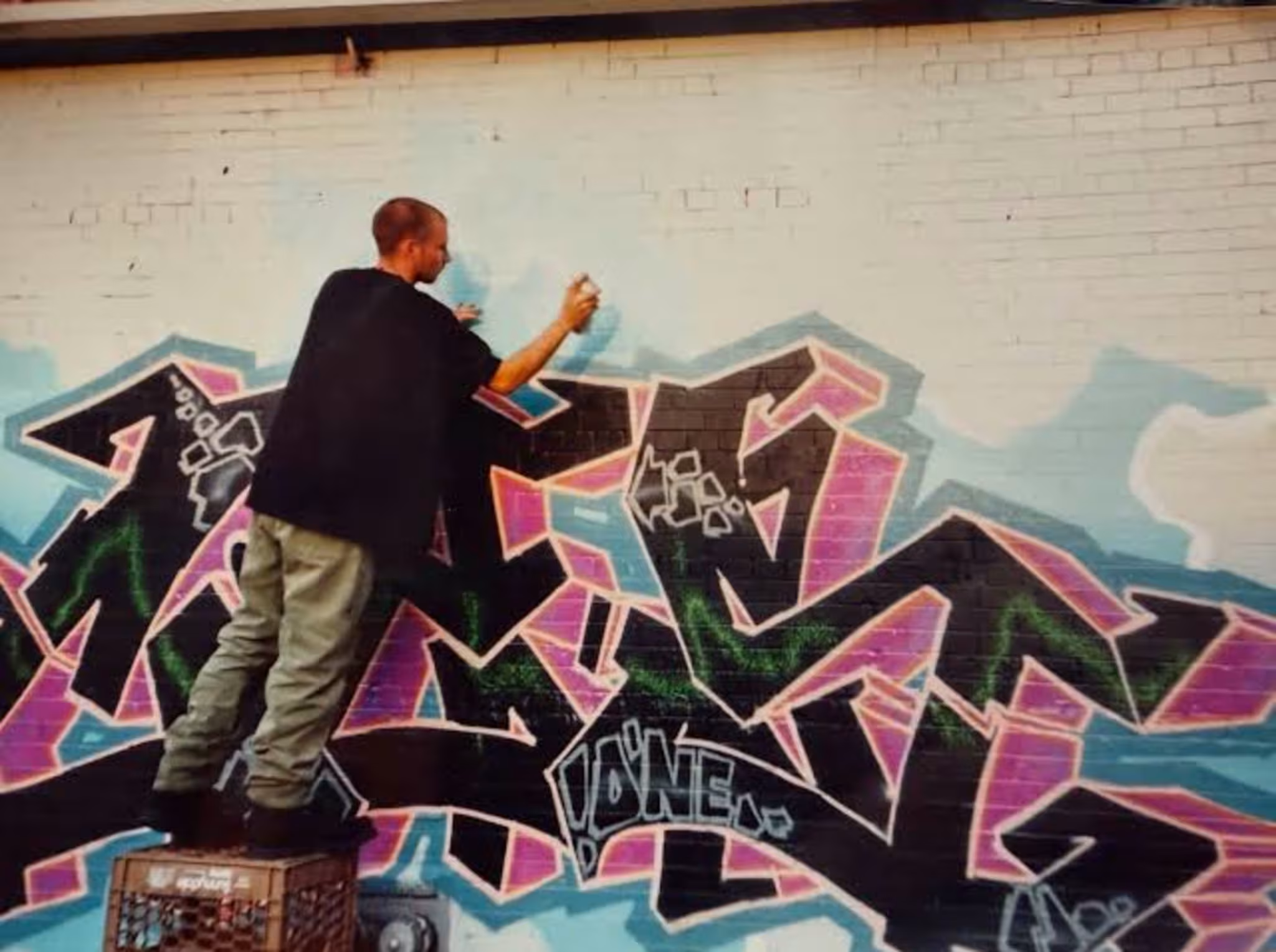
Key Takeaways
- Graffiti legend CES discusses four decades of writing, from starting at 13 in 1983 to painting worldwide with crews FC and FX.
- He credits early influences like SEEN, SKEME, and the documentary Style Wars with expanding his sense of what’s possible.
- Still driven to experiment, CES argues that true graffiti remains illegal, warns against chasing social-media validation, and hopes his discipline, body of work, and generosity will keep inspiring future writers.
There are graffiti writers, there are legends, and then there are the names that defined the culture itself. CES is one of those names.
Coming out of New York in the early ‘80s, CES has spent more than four decades building a body of work that very few can touch. From the trains and streets, to walls and galleries around the world, his name is synonymous with style, innovation, and an almost obsessive dedication to craft.
A member of legendary crews including FC and FX, CES emerged in an era where your reputation had nothing to do with followers or algorithms. It was earned through originality, consistency, respect, and hard work. And CES never stopped putting in work.
His aggressive New York letter structures, movement, color, and unmistakable approach have influenced generations of writers across the globe. But maybe what makes CES even more important is that after 40-plus years, he is still active, still experimenting, still painting and still pushing himself at a level that rivals artists half his age.
This is a conversation with a true master of style.
This interview has been edited for clarity.
Shop New Arrivals at Complex.
Take me all the way back. When did you start writing? What was the moment that made you say, “I need to do this”?
I started writing when I was 13 in 1983. I can’t really say there was a specific moment that made me say I wanted to keep doing this. I believe it was a series of things that kept happening: the adventures, the challenges, the competitiveness, and the mystery all played a part in wanting to go deeper down the rabbit hole. I remember feeling like everyone wrote in 1984; It was just part of what was happening around me, and by the end of the summer I felt I was one of the only ones left from the cats who I started with. Just when I was getting good, everyone else went in a different direction.
Before you were CES, you were just a kid looking at graffiti. Who were the first writers whose work completely blew your mind?
There are two different spaces where I existed where impact early on was a factor immediately in my surroundings. The first cat I ever wrote with was my childhood friend and neighbor Rhandy, who had many names over the years— mostly he went by RT. He was a few years older than me, and seeing the things that he was doing, both illustrative and illegally, were impactful to me. He is the first person I went painting with, racking, and did trains with. Extremely adventurous. Now, moving outside of that circle, the impact of seeing Style Wars for the first time, and some of the writers in that film were doing things I could not even imagine, and riding the trains and seeing it on the street in those days was something larger than life to me. I mean, standing in front of a SEEN piece was mind-blowing to me at that time and still is, for the most part, I must say.
New York is having a moment in subway art. Who is the king of New York right now? In my opinion, there are multiple kings in New York. It’s ever changing on the trains.
I have to give it up to APER and CRISPY. I mean, these guys are taking it to a level not many would or could. I mean, multiple whole trains, not just whole cars. The entire set on multiple occasions is some real king shit right there.
You’ve talked about SEEN and SKEME being early inspirations. What specifically did you see in their work that changed the way you looked at graffiti?
Yes, for sure. SEEN and SKEME are two of my early inspirations. I think some of the things that stood out to me from SEEN where his approach of readable simplistic, explosive letter styles with bold coloring, accompanied by the classic characters of the day. It just stood out to me, and his handle—the way he manipulated and controlled the can—stood out to me as well. SKEME appealed to me on a similar level and had the funk and flow that was just raw.
When you think about New York graffiti in the early ’80s versus graffiti today, what do you miss most about that era?
I mean, I could still close my eyes and smell what it was like to paint back then, and it was with limited supplies, colors, caps, et cetera. [You] had to rely more on style than technique and flashing us. Again, I was a kid in the early ‘80s and I was all about the adventure upon my entrance into the world of graffiti. And that was definitely a time for it. Trains were bombed inside and out; stations had pieces on them. You’d run into writers just by traveling around—no cell phones, no computers; just living and being in the moment was really what I would say I miss the most.
Back then, you didn’t have hundreds of paint colors, specialized caps, YouTube tutorials, or Instagram. You had Krylon, Rust-Oleum, and whatever you could get your hands on. Did those limitations make writers more creative?
For sure. Having limited supply and color palette really forced you to utilize your style more than relying on tricks and fancy posturing. I mean, literally searching for a can of purple from FLORALIFE was like something exotic, out of this world. So yes, if you were lucky enough to come across some of these exotics here and there, you really felt like you were changing the game. Now [there are] 5,000 shades of purple and you can order them from your bed. So the evolution of color has become endless, and so your imagination should match that.
Tell me about racking paint. It’s was part of the reality and folklore of graffiti culture. Did having to figure out how you were going to get your paint make every can and piece mean more?
Yes, for sure. Racking was a big part of acquiring supplies, from cans to caps to books to markers. [It’s] what you relied on, and it was part of the trade with a lot of risk involved. You had to learn how to navigate and spend countless hours traveling mostly with no car to acquire these supplies. So you really would make the best of what you would have to work with. I mean, I would take so much paint that I wouldn’t even wanna use it. I used to love to stare at it because there was some form of pride in coming off with a healthy stock of cans. So when you would choose to use them, you really wanted to make them count, because you knew how much work you put in to get them. I mean, some cans went into multiple pieces, if used correctly. It’s something that is still part of my DNA. I have every color, but I act as if I don’t and want to maximize each piece.
Spray-paint technology has completely changed. Better paint, pressure, coverage, caps, and an unbelievable number of colors. What can you do with a can today that would’ve seemed impossible when you started?
Yes, true. Paint technology is so advanced and it’s forever evolving. The things that I personally find fascinating about today’s paint is the superior coverage and color variety. Coming from a time where things were limited and certain cans were just—let’s call it what it is—shit. The technically advanced paint of today, you can really depend on it to make your pieces pop. And now with tens of thousands of people writing around the world, we all couldn’t do that with just 12 colors, so the paint is matching today’s movement. But yeah—even back then, I dreamed of outlining pieces with some of these light colors that just weren’t up for the task. By today’s standards, there are no excuses. Just do more!
A 15-year-old today can watch the greatest writers in the world paint online, order professional paint and caps, and learn techniques in months that took your generation years to figure out. Is that good for graffiti? Or has something been lost?
The technology today has made things easier, and [tis] instant gratification without the adventure and sharing in the fun of actually connecting and experiencing things on that level. However, if you are a driven person— somebody who’s very motivated to achieve something—it really doesn’t matter how that information comes. It’s how you process it. I’m happy to come from the generation that I did, and to still be here mixing it up with the future masters is all good with me. I mean, the truth is we are all just visiting here and trying to make the best of our time; let’s keep making great visuals that match the stories and experiences, and encourage the next generation to keep evolving.
Do you think it’s easier to become technically good at graffiti today, but harder to develop an original style?
Yes and no. I think technically good might be easier for sure, with all the tools and technology of today, but developing style is always subjective. I like what I like. You like what you like, and so on. Sometimes when things are new, it may come across strange and takes time to set in. It’s OK to be different and expand upon what has already been laid out. But there’s a lot of stuff being done that I just don’t vibe with, and that’s just where I come from. I think getting to know individuals makes it easier to digest. The differences between us aren’t so vast.
Where is the line between graffiti and art for you? When graffiti moves from a train or wall onto a canvas in a gallery, is it still graffiti? Or has it become something else?
For me, graffiti—true graffiti—is illegal and done without seeking approval or lights and cameras. If I’m painting a large scale mural, or painting a canvas in my studio, or hanging something in a museum, technically, yes I am a graffiti writer and you will most definitely see that reflected in my work. But the truth is that once you come above ground and have the luxuries of doing things for the sake of visual information and inspiration, you are now in a different category. You are now speaking to a different audience, which is fine, because there are many languages within this culture, and I am fluent in many.
You’ve been called a style master. After more than 40 years of manipulating letters, what does “style” mean to you? How can you tell when somebody truly has it versus somebody who’s just technically talented?
I'm not sure if style is something you are born with or it can be inherited. For myself, I worked very hard, and still do, at perfecting some of the simple things within style writing. So yes, style, for me, is something that is handed down from the generations before you and then it’s where you enter and manipulated it to become your own version. It’s a natural progression, if you are moving forward. And yes, I believe you can be born with style, and there are some that are just naturals and can set trends. But then there’s something called longevity and whether or not it can sustain it, or was it just cool for that moment in time?That’s a fine line to walk, being good today and still being relevant tomorrow, stylistically.
Who do you consider your peers? Who were the people you came up alongside where there was mutual respect, competition, and that feeling that everybody was constantly pushing everybody else?
My peers didn’t always start out that way. In many cases, we didn’t get along early on, and respect had to be earned. Time has a way of manipulating that and so does hard work and perseverance; there is no fast track in accomplishing respect, real respect. Not just hitting “like” on somebody’s photo. And I do believe that people are still pushing. I mean, the minute you think that you have done it all, or reached a level of complacency, I think the fun would be over. For me, I’m still fascinated. And I am extremely grateful for that, that I have not lost that drive.
Who are the writers or artists from your generation or even today who inspire you? Is there anybody who can still paint something that makes CES stop and study it?
Oh man, the list is long of artists who I admire. I don’t have enough ink on the screen to write all of their names individually. Most know who they are, and some wouldn’t even have any idea that they inspire me, so let’s keep certain things a mystery. But yes, there are things that I see on a daily basis that really make me want to get out there and go for it again and again. I never dreamed that it would reach the levels that I have, so that in itself is motivating me just to get up and look around and see the inspiration we all share communicating the language of art.
On the other side of that, who are some younger or up-and-coming graffiti artists right now who have made you turn your head and say, “Whoa, this kid has something”?
Well, with each passing year on the calendar, the luxury of time is not on our side. So the number of younger writers has become vast and the older writers have transitioned. Sorry to say, I’m terrible with names unless you’re in front of me. It's hard for me to have specifics for who are some of the great masters who are killing shit today, but that number is always growing. I mean, every city I’ve been to—and I’ve traveled around the world—I’m constantly meeting new people who are pushing the boundaries and expanding upon what we do and have done. On any given day, with all this information, I am turned onto new cats that I didn’t hear of yesterday. It’s amazing the number of talented people worldwide.
There was a time when graffiti was made primarily for other writers. Now a piece can immediately be seen by millions of people around the world. Has social media made graffiti better? Has it changed why people paint?
I think that falls on the individual, on how they utilize social media to showcase themselves, and if they want to share their work. I know personally I do a lot, and I share a percentage that I feel would be of interest. Some people overshare, in my opinion, to the point that they become invisible. So yeah, there are pros and cons with what social media has done not only to the graffiti culture, but the human race, for that matter. I mean, if you’re not enjoying what you’re doing and you’re doing it just for validation—that can be a very sad and lonely place to exist. Put this thing down and go out there and live.
What drives you to keep doing this after all these years? You’ve already earned the respect, traveled the world, and proven yourself. What are you still chasing every time you pick up a can?
After all these years, it’s who I am. It’s what I’ve become. I’ve manifested this life from a young age and to tell you the truth I still enjoy it very much. I’ve made great friends, experienced things on such a level that I could never have imagined, so I’m always open for the next mission because no two are ever the same, creatively and spiritually. You know there is no finish line with this shit.
Has getting older changed the way you paint? Not just physically, but mentally? Are you painting from a different place today than the kid who first started?
Yes. Older and wiser is what we want to believe, though some days may not show it. I’m a much smarter painter. I’m not into wasting time and paint like I did when I was younger. I’ve learned, I’ve adapted, and I am equipped with a more focused outlook. I approach things differently than I did when I was younger. Of course, a lot of that is reliant on today’s technology and advanced formulas that have evolved within the culture, from caps to colors to even simulating layouts and color combination concepts on things like Procreate, and other futuristic tools to help maximize the the end result.
If you could sit down with 15-year-old CES before anybody knew his name, what would you tell him about the next 40-plus years? And what would you make sure not to tell him?
Man, that’s a great question, and I’ve thought of it in the past. It really helps me ground myself by thinking back to how fascinated I would be these days. There isn’t much I would tell him other than to be sure to have fun and enjoy the journey. Don’t be so caught up in the details; just enjoy. I’ve known artists who, from looking at their work, you would swear they were these worldly visionaries of the future, and then when you sit with them, everything is contrived and such a regimented existence. Unfortunately, I couldn’t tell the younger version of myself what to look out for because that’s part of the process. Even the “what not to do” is something everyone needs to experience because then you wouldn’t know how great it is to make it out to the other end. I wouldn’t wanna cheat him out of growth.
When everything is eventually said and done, what do you want CES to mean to graffiti? When somebody sees those three letters years from now, what do you hope they understand about what you contributed to the culture?
Hopefully my dedication, my discipline, and my body of work will visually speak [and] words won’t be necessary. I would like to be remembered as a good person more than anything and someone who gave all he had to what he believed in. I think inspiring people is one of the greatest gifts you can share and if that’s tomorrow or 50 years from now, I hope to keep inspiring people for a very long time, as I have been inspired by many.




