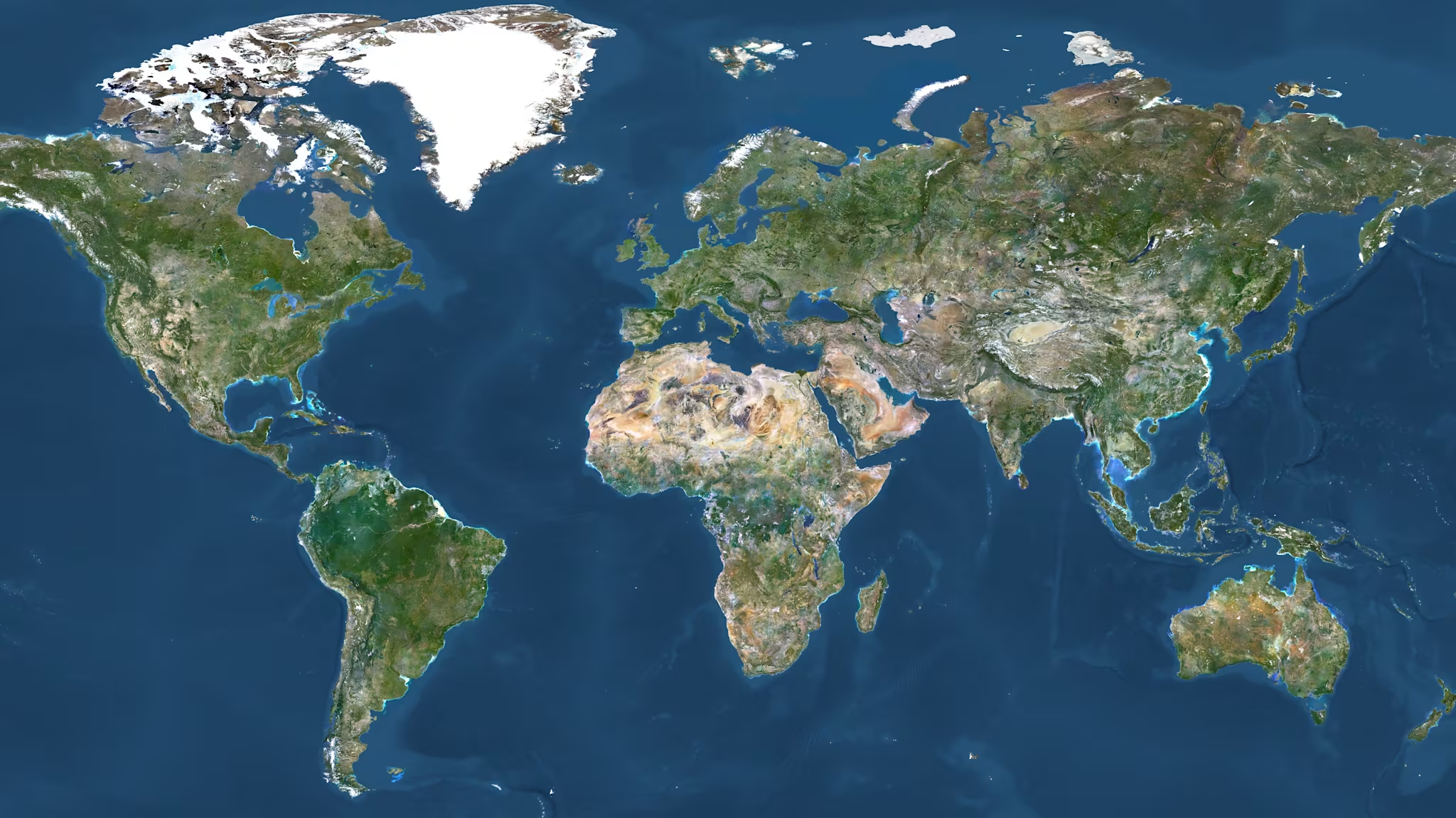
The United Nations is overwhelmingly in support of an effort to change how the world is represented on maps, focusing on correcting distortions that have long made Africa appear significantly smaller than it is.
On Friday, the UN General Assembly voted 164-1 in favor of the "Correct the Map" resolution, which encourages governments, schools, international organizations, and technology companies to use equal-area projections when relative geographic size matters.
Togo introduced the resolution on behalf of the African Group's 54 member states with support from the African Union.
"A fair map does not change the geography of the world, it changes how we see the world," Togo's Foreign Minister Robert Dussey said, according to UN News.
"A map is never neutral," he added. "It shapes perceptions, influences how the place of peoples and continents in the world is understood."
The resolution takes aim at distortions created by the Mercator projection, a map developed in the 16th century for maritime navigation. Mercator enlarges land masses closer to the Earth's poles, making regions including Europe, Russia, and North America appear larger relative to areas closer to the equator.
Africa covers approximately 11.6 million square miles and is about 14 times larger than Greenland, despite the two appearing relatively similar in size on many Mercator maps. French Foreign Minister Jean-Noël Barrot highlighted the issue ahead of the vote.
"In that map, the United States, Russia and China take on a disproportionate visual prominence compared to Africa, Latin America, or Southeast Asia," Barrot said, per Al Jazeera.
France also announced plans to move away from the Mercator projection on its official world maps. One alternative is the Equal Earth projection, created in 2018 by cartographers Tom Patterson, Bernhard Jenny, and Bojan Savric. The projection preserves the relative surface areas of continents while maintaining recognizable shapes.
"Wow. When we created the Equal Earth projection in 2018, we never imagined this," Patterson wrote on social media after the vote.
The United States cast the only vote against the resolution. Yaryna Ferencevych, U.S. deputy representative, objected to its references to "reparations" and "cognitive justice" and criticized the UN for "debating map projects from the 16th century" rather than more pressing issues. Six countries, including Ukraine, abstained.
The African Union had already adopted the Equal Earth projection across its 54 member states in February. The UN vote now brings the effort to change how Africa and other regions are represented on maps to the global stage.




