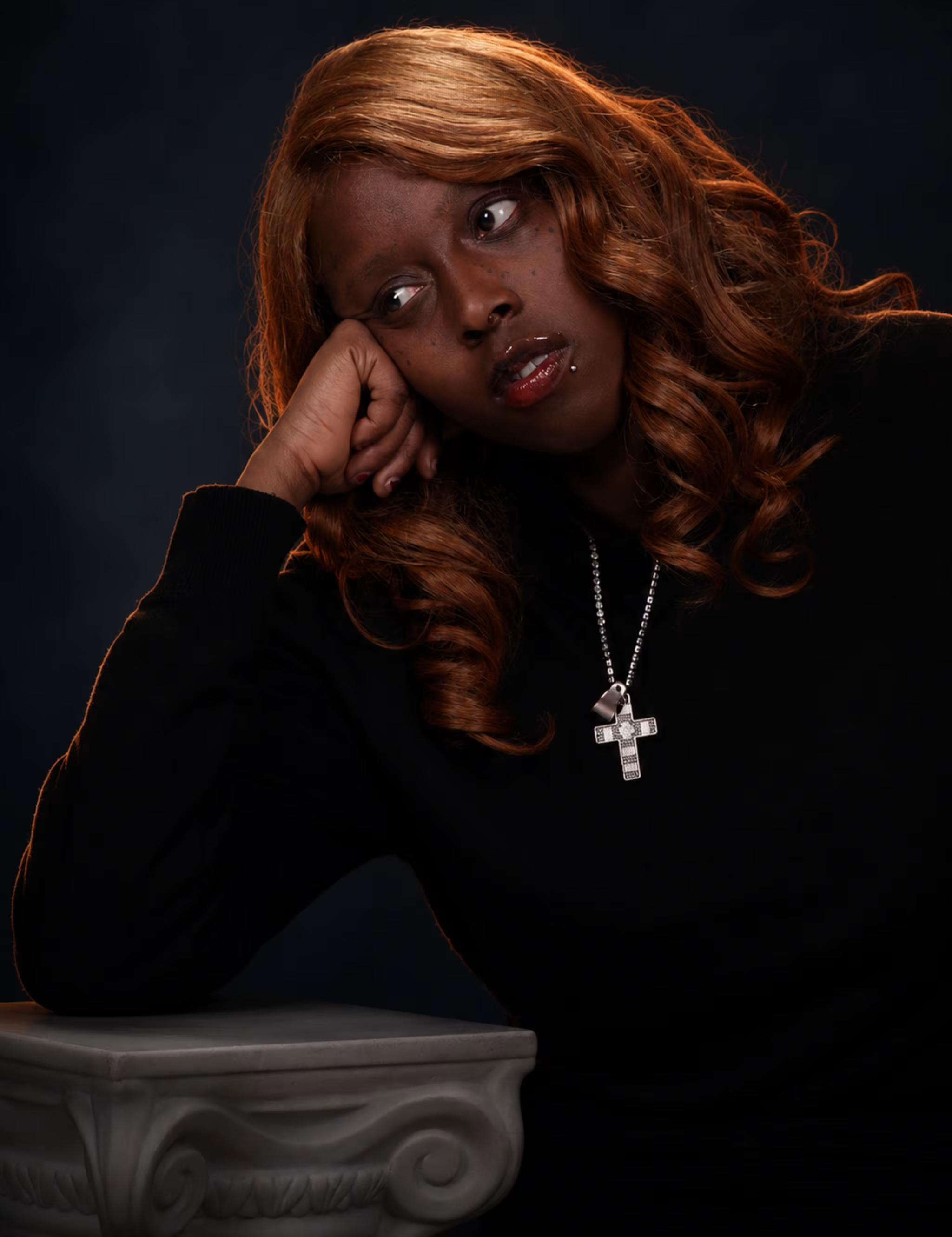
“Whenever I started making stuff, especially stuff without vocals, it felt like I could dream,” Klein tells me following the release of her latest album, my own fairytale. “You know the Disney intro where they write the name in sparkles? I always felt like that.”
Across twelve tracks, the album pitch-shifts and layers looped police sirens, TMZ-style paparazzi clicks, fireworks, gunshots, whistles, samples from reality TV and popular game shows, and Klein’s own voice, sometimes stretched and strained, into something that sits somewhere between gospel, R&B, rap, grime, leftfield electronic, noise and modern classical. For this South-East London native, music is a soundtrack to everything else she does. She is also a filmmaker, playwright, painter, sculptor, archivist and, in her words, a one-woman TV network.
Media-making runs in her family. Klein’s older sister came up in the early SoundCloud rap era, working with JPEGMafia, Metro Zu and SUPERSUPER while still a kid. When their parents found out, both sisters were grounded, sent to a military-style camp and banned from anything creative. Klein responded by building her own public-access channel, Wahala Wahala Wahala, which broadcasts her work alongside public submissions. Her YouTube channel works the same way as a mini-network of pilots, mini docs, audition reels and music videos dating back to 2011, including an Ed Sheeran anecdote and her stint on Battlefront, Channel 4’s Emmy-nominated youth campaigning series.
Klein’s first feature film, Care, began as a 2018 musical at the ICA in which Disney princesses meet the UK care system. She wrote, directed and scored it, casting Kibo, Lengurz from Burnermunde, Vivian Oparah, Mica Levi, kids from local community centres, and poet Fred Moten as her dad. It now exists as a social care website. She has made plays with artist Solomon Garçon and shown alongside Arthur Jafa and Crystallmess, but most of her art lives in flats, squats, the street and Moonshine Lounge, a Nigerian restaurant in Dalston, much of it gifted or sold for a pound. Klein’s my own fairytale album carries that spirit into Disney territory, while also drawing on old anti-bullying campaigns and Malcolm X’s 1964 speech on Palestine.
Running through all of it is a fascination with realism, with what is scripted, what is real, and how the media we consume can end up consuming us. At the ICA last month, Klein marked the album release with a reenactment of the Trueman family from EastEnders, bringing together DJs, artists and actors, such as CHAMBER45, Ashden Oke and Sasha Scott, for the performance. We caught up with Klein to discuss the ICA show, the making of her my own fairytale LP, her fascination with Disney and reality television, and the ways music, performance and personal history intersect in her work.
COMPLEX: The ICA performance felt almost like it was a play. Some of the performers told me that your shows are usually more improvised, but this one felt more rehearsed.
Klein: This performance was more rehearsed; we had a soundcheck! I think that was the difference. Normally, I work with people who have the same kind of experience with music or art as me. Sometimes, that’s people who’ve never played instruments before, and it’s a musical charades kind of vibe: we pick things out of a lucky jar, and someone plays this, or someone does a comedy skit. This one was more chilled. I cast people as extras and I based it on the Trueman family in EastEnders. They were meant to be unknown characters that Ben Wadey hasn’t brought in yet, plus some past characters too. Elements of it reminded me of a play I did called Psalm’s Trust, Volume Two. In that one, the main character becomes a background character in her own soap within about ten minutes. At points, the performers were extras and I was the main character, then I was the extra, fading more into extra, extra, extra, extra towards the end. The performance had a scripted-reality vibe, and that’s always been in my shows. Sometimes it’s rehearsed, sometimes it’s intuitive. Most times, my agents don’t even know. They find out when everyone else is watching the show, like, “Oh. Oops.” I like plays, and I like making plays. I’m a big fan of the old Black plays, from the likes of August Wilson and Ishmael Reed. I can’t lie, I even like the old Tyler Perry stage plays, and it kind of felt like that as well, with a twist.
Why did you decide to fold the Malcolm X speech on Palestine into “man in the mirror”?
In my head, it’s already explicit enough. In most of my work, I seep in things that are actually happening in the real world, alongside someone getting chirpsed at a club or crying because their boyfriend left them. It also plays after an anti-bullying campaign track I did. I’m interested in looking at the past and how nothing changes. That speech was given 60 years ago, and it’s still present. The same cycle repeats itself. “man in the mirror” has multiple meanings for me. Part of it is me wishing I could be a man, to do certain things, to fix certain things, to help people in my life, to have the strength not to be afraid. Malcolm X wasn’t afraid. He wasn’t afraid to die. And every time I play that clip, I’m like, “I guess I’m not afraid to die, too.”
Setting a speech about a people being dispossessed against a song about looking at ourselves in the mirror is such a powerful combination. Your latest album, my own fairytale, has been described as a dark Disney soundtrack, and in 2018, the ICA commissioned a play that you directed called Care. Disney was heavily referenced in the play. Why do you keep coming back to Disney?
I grew up watching Disney. Some of it’s cool and interesting, some of it’s not for me. The music in Bambi was just so perfect. When I started making stuff and looked at my reality, my reality didn’t feel like a Disney film. Whenever I started making stuff, especially stuff without vocals, it felt like I could dream. Not like Fantasia exactly; you know the Disney intro where they write the name in sparkles? I always felt like that. I was listening to a lot of what some of the Disney dudes were making, and I was like, “I think my stuff is up there.” That’s the rapper mentality in me. I was being literal too, thinking, “This literally could exist in Disney. This sounds like a dark Disney soundtrack. What the hell is this?” Some of what I make sounds like what I imagine the future might sound like. But some of it just sounds really old, like really old composition styling, and I find that eerie and funny.
I didn’t grow up making music. I wasn’t taught, and I wasn’t trying to be a musician or an artist. I was testing things out, playing with things in my house and turning them into instruments, playing with voices and my own voice and manipulating it. It ended up sounding really whimsical. Some of the stuff for the album was giving 1920s. Then my family friend’s kid was the one who said it sounded like Disney, and I was like, “Oh my god, it does. It’s a dark Disney tone.” So I felt it, and a baby felt it too. I think having a baby critic helps.
There’s something eerie about Disney, the fact that Disney relays these fairytales to us, but it’s also one of the biggest corporations in the world. Were you thinking about the tension between making something so personal and using the language of a big corporation?
You know what’s crazy? I never thought about that. The things you consume sometimes consume you, and you don’t even know why. I think about that with Zeus Network. If you’re a Zeus Network fan, you probably grew up watching Bad Girls Club, which was just shared around at school, and you become part of it without realising. You are the corporation; the corporation is for you, the corporation is against you. It’s all-encompassing. But the corporation also makes you romanticise things. You see a frog and you go, “Oh my god, The Princess and the Frog.” I want to do a stats thing to see what happened when The Princess and the Frog came out. Did people start being nicer to frogs? Did Disney play a part in that?
There are so many layers to the album. Even song titles like “the illuminati ends now” and “suspect” make me think of conspiracy theories. And Disney fairytales play with identity too. Sometimes the princesses are in disguise, or characters are dressing as someone else. Were you thinking about that?
At my school, everyone was watching conspiracy videos. My friend sent me a video about the Illuminati, and how if you play a song backwards, it says “I am the da-da-da.” I think it was Snoop Dogg or someone. I literally didn’t listen to radio music for three weeks. Then, after that, I was like, “Who cares?” You can rewind anything and it could be anything. Earlier this year, I was part of a group show of paintings, and a lot of it was about hauntology. I dedicated my paintings to conspiracy theories. Some were the general stuff people know: the symbols, the hands, the eyes. Then some went into questioning: “Is Sneakbo a cat? Did he turn into a cat in McDonald’s that time? Does everyone on Zeus Network get sent a crazy contract? What’s the Zeus Network contract?” Everyone’s trying to find that. It’s always been something I’m interested in. But when I made “the illuminati ends now”, I wasn’t making it about the Illuminati. I was in a very zen mode, playing my synth and putting things together. When I listened back while putting the tracklist together, I was like, “Ooh, it sounds like the soundtrack for an Illuminati documentary.” I got really spooked out because it sounded too mysterious, like a psychological thriller.
A lot of my titles are placeholders, literally what I’m thinking at that moment, so it was like, “Hmm, I actually gotta make a documentary or a play on the Illuminati.” Then I was like, “Never mind,” titled it that and kept it moving. With the princesses, I’m interested in the different versions of ourselves that we present to ourselves and to other people. The shadow self as well, because both can exist at the same time. Me and my friend were talking about the Lifetime film on Wendy Williams; it presented so many versions of her, including the versions she presented to other people. It was iconic, but it was triple meta. I was like, “That’s interesting.”
That idea of presenting different versions of yourself feels like it runs through all your work—the person on stage, the person on YouTube, etc. Does that carry into your music videos?
The “c thru me” video is essentially a pilot series I made. Most of my YouTube channel is pilot ideas or play ideas. I don’t have a traditional website portfolio, so I usually get art shows from people coming across things on my YouTube. I’ve always wanted to make a show with a Zeus Network kind of vibe, but I’m also a big fan of Real Housewives, and a really big fan of Mona Scott-Young and Love & Hip Hop. Love & Hip Hop: New York season one, and Love & Hip Hop: Atlanta seasons one to six, were some of the best things ever. For the video, I cast iconic New York strippers, baddies who have real lives and real jobs. One of my friends is in it; she’s an incredible designer, and a psychologist in the video as well. The music video is framed as everyone coming to hang out and dance, but I pulled from my reality TV background. As we start filming, I tell them we’re filming and that it’s scripted reality, but everyone forgets. Then I start telling people secret things they have to do, like a showrunner. That’s very similar to how my live shows work with lots of people: everyone is as surprised as each other when things happen. I’m always intrigued by how much is real when things are being guided or manoeuvred.
I always find it interesting that a lot of my recorded music sounds old as hell, and whenever people find out it’s made by a Black girl, how they see it completely changes. I’m like, “Bruh, if y’all didn’t know it was me, y’all hoes would think it’s Hans Zimmer.” That’s why I stay on Hans Zimmer’s neck—allegedly! I still have some respect for him, but I do think that’s very interesting. That’s why I don’t shy away from being called a musician anymore. I’ll listen to things like Finding Nemo or Interstellar and I’m like, “Bro, some of this sounds like my early Year 9 projects—allegedly!” And my projects actually have soul and a bit of road in them. So I don’t shy away from that term anymore.
It’s interesting how you approach music videos through reality TV, questioning how much is scripted, how much to allow for reality to happen and how much is preconceived.
To someone else, it’s a video, and it can be whatever you want it to be. In my head, it’s a pilot series to show I can make a pilot series and present it to Bravo. I’m really on my “Oh shit, for this episode, Andy Cohen” thing. Then the music gets placed with it because it has to exist somewhere. I’m soundtracking the things I want to see, the films I want to see, and the two go hand in hand. That’s what my YouTube channel is: some of it is audition reels, some of it is fully formed ideas, some of it is a documentary but framed as a music video. It’s playing with the idea of how to communicate ideas across different mediums.
You sample a lot of TV game shows too, like Who Wants To Be A Millionaire and EastEnders. Why bring those in?I worked in TV so I’m a big fan of British soaps, EastEnders in particular, and Nigerian soaps—there’s a Nigerian soap called Super Story. Who Wants To Be A Millionaire is interesting, because it often feels scripted, down to who they have as their phone-a-friend. I used that sound in the live show because it always gave me the spooks. It feels the same as a police siren. That’s my only relationship to that sound. The TV stuff is because of my background. I worked on Britain’s Got Talent as a runner, and eventually I worked as a transcriber and logger on another reality TV show. I’ve always been interested in taking things from real soaps that people are familiar with, putting them into a play or something I’ve made and having them become another character within it. Most of the time, I just pull from stuff I like and watch, and try to understand it in the context of what’s happening right now. In the ICA show, I pulled from anti-bullying campaigns. I started thinking about the idea of bullying: bullying an individual, then bullying a country, then bullying a race, bullying someone for their religion. I was like, “Oh, this goes beyond someone trying to bully me.” That’s why I’m interested in TV. I also worked as an archivist, which was really random. I got made redundant after about a year and a half into it. Me and my friends were really sad because we thought that would be our career for at least 50 years. I’ve always been interested in looking at the past, at how it plays into what’s put in the media, and how that plays into our decision-making and how we see other people.
Every Disney princess story has a villain or a curse, or some sort of tragedy. Were you thinking about that on this album?
The record was pretty much done until towards the end, when “man in the mirror”, “bridge the gap” and the other tracks with my voice came in. Randomly, I was like, “Wait, am I the black sheep in my family?” I started thinking about the dynamic of my family, my relationship with my family, my relationship with my sister. I’m constantly in two minds about whether I’m the black sheep, or what went wrong in our relationship. It could be better, but it’s chilled now. That’s something I think about. That’s why there’s “bridge the gap”. It’s like, “Mum won’t even talk to me, dad too. Why does my sister hate me?” I’m trying to wrestle with what’s going on. I come from such a weird family. It’s a very strange dynamic. But essentially, I’m the black sheep. It’s strange too, because my sister was also making music. At points, I was like, “Oh my god, who’s the Tethered version?” People have reached out to me about her thinking it’s me, and I’m like, “Nope, that wasn’t me; she did that.” She had the craziest life but she got completely disillusioned with everything she saw and experienced in the industry, and so she left it. I don’t know how my family would feel about me doing any of this, because they don’t really consume secular media. They don’t even know what I do at all.
What are you working on next?
I’m looking forward to doing a little one-two play. I really want to be in musical sketch shows. I’m talking to a few people, so I can do my little 30-second monologue for SNL. If I did my SNL skit, I’d probably get kicked off midway. Otherwise, just continuing living, taking life step by step. I said something to my cousin the other day that made me laugh: “Yo, we just gotta keep jazzing, man. Keep jazzing with life.” I was laughing because I sounded like someone from an old Spike Lee movie. We just have to keep jazzing with life. That’s all I can do. Keep jazzing.