Key Takeaways
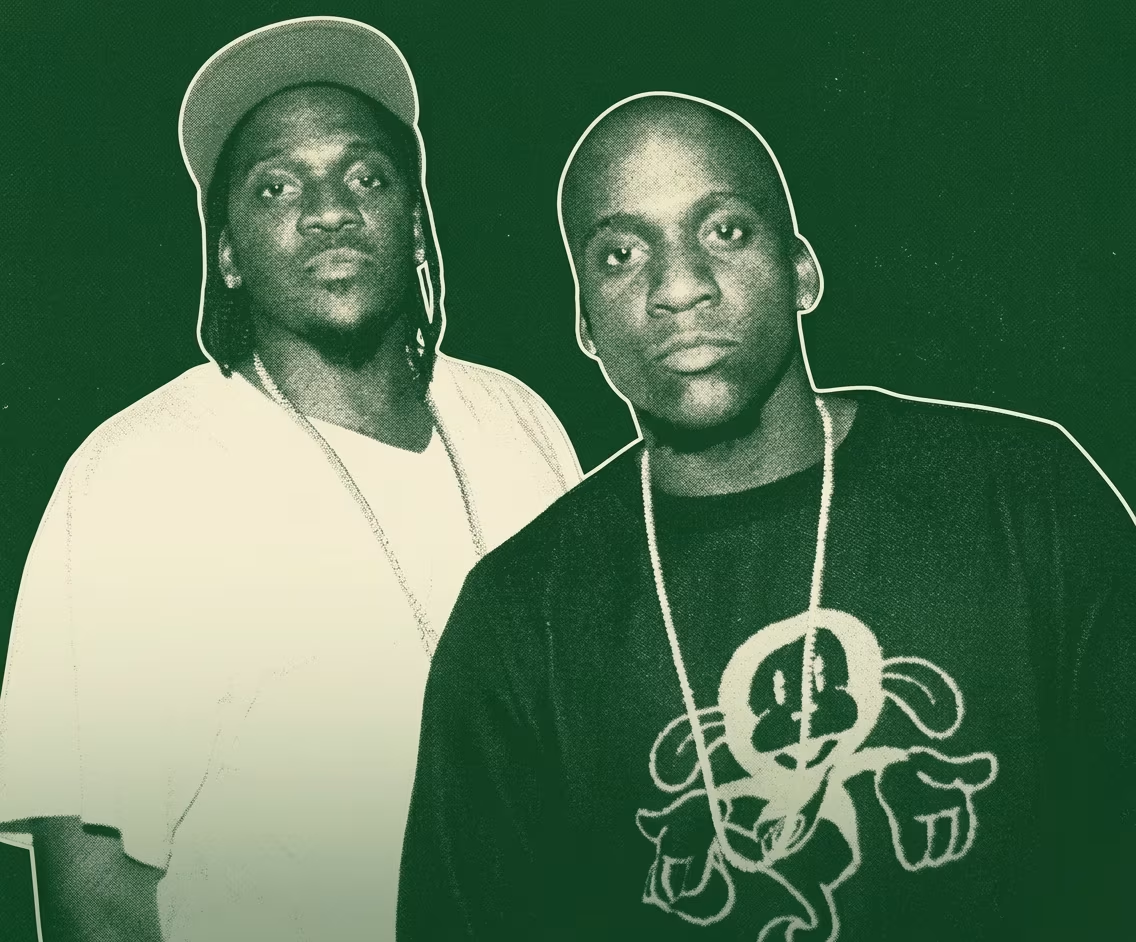
- Rolling Stone reporter Cheyenne Roundtree expands her investigation of Sean “Diddy” Combs into Bad Boy for Life: The Rise and Fall of Sean Combs, tracing his career, alleged violence, and 2025 criminal trial.
- Roundtree says her reporting uncovered a recurring cycle of harm, limited apologies, and self-justification, alongside earlier allegations and incidents that often disappeared from public view.
- The book also examines Combs’ Howard University years, Bad Boy’s rise, the Biggie and Tupac era, his media manipulation, and what he may say when he leaves federal prison.
Reporter Cheyenne Roundtree (along with her colleague Nancy Dillon) blew the case of Sean “Diddy” Combs wide open with her May 2024 Rolling Stone story Bad Boy for Life: Sean Combs’ History of Violence.
Coming less than two weeks after the release of the video of Combs beating Cassie Ventura in a hotel—and just a few months after her blockbuster lawsuit—the story was the most in-depth reported look into the dark side of the mogul
Now, having continued her reporting through Combs’ 2025 criminal trial and beyond, Roundtree is telling the full story. Her new book, Bad Boy for Life: The Rise and Fall of Sean Combs, published today, is a deeply reported tome, full of surprises about every aspect of Combs’ life and career.
I called up Roundtree—who, as you’ll see, I met when we both covered Diddy’s trial. We talked about that very strange experience, the secrets she uncovered while writing her book, and what she’d ask him if she ever got the chance.
This interview has been edited for clarity and length.
How did you go from the Rolling Stone article to a book?
Roundtree: When we published the initial investigation, our first draft was 20,000 words. It was so long. There was so much material left on the table. It came out in May (2024), right after the the hotel video had dropped. There was a whole other question of what comes next that hadn't been answered.
So we were continuing our reporting, or at least I was keeping tabs on it. And then by September, he was arrested and it just seemed like a natural progression of like, OK, there's room. And my agent was like, this is where the reporting begins. This answers, will there be consequences?
And so from there, just continued on my reporting with Rolling Stone, and there was just so much left on the table that you can't fit into an online piece, let alone a magazine piece, that it just made the material for the book.
What was the biggest challenge in researching the book?
One of the biggest challenges is, because there's so many lawsuits wrapped up in still pending litigation, that presented a challenge in terms of getting people on the record, just because they have to protect their own self-interest with their litigation.
And then after the trial, I think a lot of people felt, “OK, that was his justice. I don't need to pile on. I don't need to kick a man while he's down.” There was that reluctance to talk anymore about about Puff.
People had lots of different polarizing viewpoints, and it was challenging trying to express all of that in the book, because he means so many things to so many people.
It’s interesting that you say about the trial. Maybe it was just the vantage point from which you and I were watching it, but the feeling seemed to be that he escaped, right? He got off.
Yeah. It was a layer of that: “He got off. There is no more we can do. There's no more to say. After you hear all of that stuff, what else can I say that can change that opinion when he's been cleared of these most egregious charges?”
It’s exactly what you said. It's that idea of: What more can I add? He's already gotten off and I can't keep going down this path.
One of the big themes of the book ties into that, which is that he hasn't acknowledged any wrongdoing. Beyond the obvious legal reasons to not admit wrongdoing —because his appeal is still going on—what do you think is behind that?
I think he can be really self-justified in his behavior. Someone explained that it's like a child—my behavior is the consequence of your actions. I don't love how I responded, but you pushed me to the point that you caused this outburst from me.
You see the pattern of something happening that he's clearly responsible for, a half-hearted apology or acknowledgment, and then fading back to a full circle. This endless cycle of harm, apology, repeat, and forgetfulness. It's kind of fascinating.
The strategy, at least as far as what we saw in the trial, was to apologize only for what you absolutely can't deny.
Yeah, right. There was also that justification. I think you were with me when his attorney called his relationship with Cassie “a great modern love story.” And everyone was just kind of like, “what?” I get that that's a defense. But it spoke to this idea: I will apologize for what I have to—but there's a condition to that apology or there's a reason why I'm not going to 100% apologize for everything.
How did you manage to condense the whole seven weeks of the trial into a single chapter?
People already knew so much about it. What I tried to do was not go into the ins and outs of the trial, but put those moments that came up into where they lived on the timeline. I stuck to the atmosphere of what it felt like for all these ghosts of his life to come back and challenge him for the first time. Also, to me what was most interesting is what the prosecution might have gotten wrong in how they presented the case.
It was such a complicated, sprawling case. But at some point, for me, it became about: We established that there was this pattern of domestic violence. Why are we hearing about this from a makeup artist who was only there for one incident? I wanted more talk about the coercive element that ended up being such a pivotal thing that the jurors were left to decide—what is coercion? I wish that they had spent more time on trying to draw that out.
A potential government witness you spoke to said that there was something to this Mark Geragos “six pack of white women” thing—that the optics of having all the prosecutors be white women did have some kind of negative effect on the jury. Do you agree?
I think the source was speaking to this idea of, they’re getting this narrative wrong. This is not your traditional cookie cutter white collar crime case. This is steeped in music, in hip-hop and the Black community. And what you're presenting and how you're presenting it is not going to register. It's not going to land. Obviously, I think that source was right—they weren't able to stick those charges.
There's a moment in the book where you’re talking about the abuse that Diddy’s mother reportedly inflicted on him in childhood. There's an implication that she might have been trying to beat something unmanly out of him. Who was it who said that?
I believe it was Tim Patterson, his best friend. That question has always been—especially during the trial—that element of his sexuality has been made fun of or insinuated. But that's what this one source who grew up with him felt. They didn't have an answer for it. I didn't want to make any presumptions about that either. Let Puff address that, if he ever wants to.
There’s another layer to that too: there were so many things that seemed to have bubbled up in his childhood, and to what degree they played a role in his own life, his own view of his own relationship dynamics or sexual habits, I think that's all still a question mark.
I want to move into his college years. What impression did you get of a Howard University-era Sean Combs?
It’s where he came into his own. In his high school years, his buddies or people that knew him were like, “He was not this larger than life guy. He was cool… he wasn't ‘Puff Daddy.’” And then suddenly in college, everyone knows him. He drove around a convertible. He was in the mix. It just seemed like he was able to find himself in a way that hadn't registered from the year or two years before.
It was so remarkable because he was only there for like a year and a semester and some change. By the time he was back in New York, he was Puff Daddy in the mix. He seems to have found guys that he really clicked with, and they were able to make magic together.
The domestic violence incident at Howard that you talk about in the book: had that been previously reported?
That first surfaced in our first report for Rolling Stone. Nancy Dillon was the one that was able to find that, and I was able to help her corroborate that. But that stuck out to me: before Cassie, before anything with [ex-girlfriend] Kim [Porter], there was something that happened that people on campus knew about.
When I was going back through the archives, I found an interview he had given to Essence talking about that specific girl, comparing them to Romeo and Juliet and saying, I had to go away because of her parents didn't like me. And the truth was, her parents wanted to get her away from you. You were able to spin this awful story into a star-crossed-lovers trope to make the reader feel bad. He said that he doesn't love anymore because of that. It’s this crazy self-justification or rewriting history to serve his own narrative.
There are a lot of rabbit holes to go down when talk about Diddy’s life. From something as basic as where did his nickname come from, to what happened at CCNY, to the Biggie and Tupac murders. How do you figure out when writing about these things, how deep to go?
I try to go as deep as I can find a solid answer to. I know when to turn back around and say, “OK, we're ending this here.” But yeah, there's so many questions still. And I think that's part of his mystique.
When it comes to his nickname: He used to say, I'm Puff because I was mad. But then somewhere along the way he decides, oh I'm not talking about that anymore. So it almost creates this illusion that there's something that we don't know about him.
With the Keffe D/Tupac/Biggie stuff, that now has been kind of solved—at least one portion of that. We'll see if police want to go down that rabbit hole anyway. They haven't considered him. They've never said he was a suspect. Keffe D maintained that story [about Diddy offering him $1 million to kill Tupac], but it never really seemed to have legs.
Diddy starts throwing parties in the late ‘80s, early ‘90s in New York. How did the people you talked to speak about those days? And what differences did you notice from the nightlife of your going-out years?
I mean, it sounded incredible. People would smile talking about going to one of these parties, whether it was one in New York, one in Howard, one out in the Hamptons if they were lucky enough to get the call up. But it was pure fun, it sounded like.
I was born in the ‘90s, so my going out years was like 2010s, when social media is just coming out. It just sounded so much different and carefree. To reconstruct that, it was just this idea of speaking to how fun it was, and it was the only place to be. Everyone was cool. It’s not this tiered social nightlife that we have now with private members’ clubs and all that other stuff.
What was it like going back and listening to the music Diddy was making at the very beginning of his career—the Father MC and Heavy D stuff?
When I was writing those early chapters, that's exclusively what I was listening to. I think Jodeci is on my top playlist for this year.
It was fun. You can hear how much hip-hop has evolved since those early sounds. But I was struck, especially when Puff moved into his own music, by the emphasis on good times and fun, that had a totally different sound to like what we're hearing today.
I was definitely the B2K, Danity Kane era. So it was fun to be like, “Oh my God, I had no idea that he was on that.”
What was the biggest surprise for you in your reporting about Diddy?
There's a couple of things. One thing I was shocked by was that there’s this trail that was able to be very smushed out, in terms of little lawsuits and little infractions. At the time when they surfaced, it's easy to say it's a money grab.
We see a scuffle sometimes with a celebrity and someone's like, oh, I'm going to sue you, and it's the most stupid charge ever. But there was that trickle across things and it kept popping up, and it had to do with his temper exploding. There was actual aggression. And then things just went away. Seeing how often that happened was surprising.
One thing I kept coming back to was that incident at the hotel room at the Ritz-Carlton [a 1997 incident, mentioned in the book where a couple in a hotel room on the same floor as Bad Boy complained about the noise, heard a bang during the night, and awoke to a bullet hole across the wall from their bed and a 9 mm bullet on the floor]. We don't know who exactly was in the room beyond the fact that the room was registered to his security. But I spoke to this husband who’s like, we knocked on the door, and I woke up and there was a bullet hole so close.
Prosecutors in New York try to get this guy to come to New York to testify at the 2001 shooting trial, to show a pattern that his crew traveled with guns, that guns were part of his lifestyle. And he was like, “No, I'm scared. I'm not going.”
The pattern was repeating itself. How similar the 2001 shooting trial seemed reminiscent of the trial that we just lived through—when publicists are in the corner, people were outside, prosecutors are trying to lure victims to come testify. All of that was scary similar.
Between the trial and the other research you had to do, you're exposed to hearing about lots of horrific stuff. How do you deal with that?
I don't know.
You just do. And I just was reminded that it's not about me. It's just making sure the people that actually live through this were represented.
There is some music in the book, but not a lot of detailed breakdowns of songs or albums. I was curious about the decision not to focus on that when you're writing about a musician.
In the early chapters, I do try to set out, this is where he got his platform with Mary J. Blige and Jodeci and obviously Biggie. But then as the years go on, I wanted to emphasize everything else he was doing in addition to the music, especially because people familiar with his albums.
I do reference when Last Train to Paris comes out, or when he's working on this ketamine album 11:11. Those are footnotes. When I was looking at it in terms of what he was dealing with, the music almost seemed to come secondary in his own life.
Obviously he was always busy working on stuff, but his life really did seem to be consumed later on with these freak offs. And I wanted to showcase that the music did seem to take a back seat when he was preoccupied with everything else that was going on.
There's this moment in the book that really struck me. After Diddy and Cassie break up, he plants these stories about how he needs to get her back and how much he loves her. Looking at it now, knowing the context, it's really shocking and kind of sickening.
When you were looking back at those stories, how did you think about it?
It made me think that the media had been played for a fool for a long time by him. He knew how to manipulate the media for his own advantage. Obviously he knows why they broke up and knows that she's moved on, and he's moved on as well. But it's still painting this narrative of, “Poor him. Why won't you get back with him?” He had to go through public channels to reach her because she was not responding.
We saw that on the stage with the BET Awards. He couldn't get through to her, so one of his tools to reach someone is mass media. It's not a second thought to use to use it that way, which is scary.
When you cover the Quad shooting [Tupac Shakur was shot at Quad Studios in New York in November, 1994. Shakur openly accused Biggie, Diddy, and Bad Boy of knowing about it in advance, which they denied], the book implies that it's at least possible Diddy was involved. I'm curious how you keep all the perspectives and possibilities in balance when writing about that. And do you have an opinion about it?
Again, that's one of the many mysteries around Puff. Is he responsible? To what degree? Or is this just really, really bad luck that he has in terms of being placed in squarely in the middle of things? With the Quad shooting, I don't know, but Tupac was convinced about it.
There was this escalating tension that wasn't going to be stomped out until both Biggie and Tupac were dead. I don't want to say that it seemed inevitable that there were going to be deaths, but at the rate that things were being stoked and stoked and stoked…it was awful.
What I was trying to to show was that in terms of his public persona, there was a real distancing of Puff to be this clean cut, clean image guy who was saying, “I only want peace. It's all love.” But at the same time behind the scenes, his bodyguard Wolf was in a mob, his best friend Corey [Jacobs] was literally the center of a drug trafficking organization down in Virginia. There were these ties.
I’m not saying that he was responsible for his friends, but this was part of his life too, and I think he did a really good job of elevating himself above it. With Keffe D, there were real connections to him for protection when they were out in LA. So I think the implication is just, we don't know, but this is what he was up to.
How did you find all the Lipstick Alley threads that you quote so extensively in the book?
Lots of Googling! But when you asked earlier what caught me by surprise, I think it was maybe that. There was this base of people who were clearly invested in his life, and someone was a great source within that, because they knew everything. Things that were mentioned in a thread ten years ago ended up being verified and corroborated almost verbatim at trial. So that's what took me by surprise—the idea that this was always under the surface.
At some point in early 2028—or earlier, if the appeals court decides in his favor—Diddy is going to be out of federal prison. What do you what do you think is going to happen?
He'll definitely have his own piece to say. There hasn't been a time where he hasn't been able to say his piece. And one thing I think is quite remarkable about Sean Combs is that he's not afraid to take things on head on. With CCNY, he did a press conference. The [Club New York] shooting, he gets in front of the mic, he says his piece. I don't anticipate that changing when he gets out.
So I think he'll have something to say. I'm just curious what that is. But he's always believed in his own myth, and so I think he will want to correct that or start this new chapter as Love.
If he agrees to do a sit down interview with Cheyenne Roundtree, what's question number one?
If he holds a grudge against Cassie. I'm really curious how he views that, because when she was on the stand, she said that she loves him. She doesn't hate him. With Jane, she said something to that effect. And I'm curious if he holds any type of resentment towards them, if he's made peace, if he understands why they felt the need to talk about it. I think I'd be most curious about about that.