As America celebrate its 250th anniversary, the BLIS Collective spent the last weekend in June posing a question: What if the country's future began by telling a fuller story about its past?
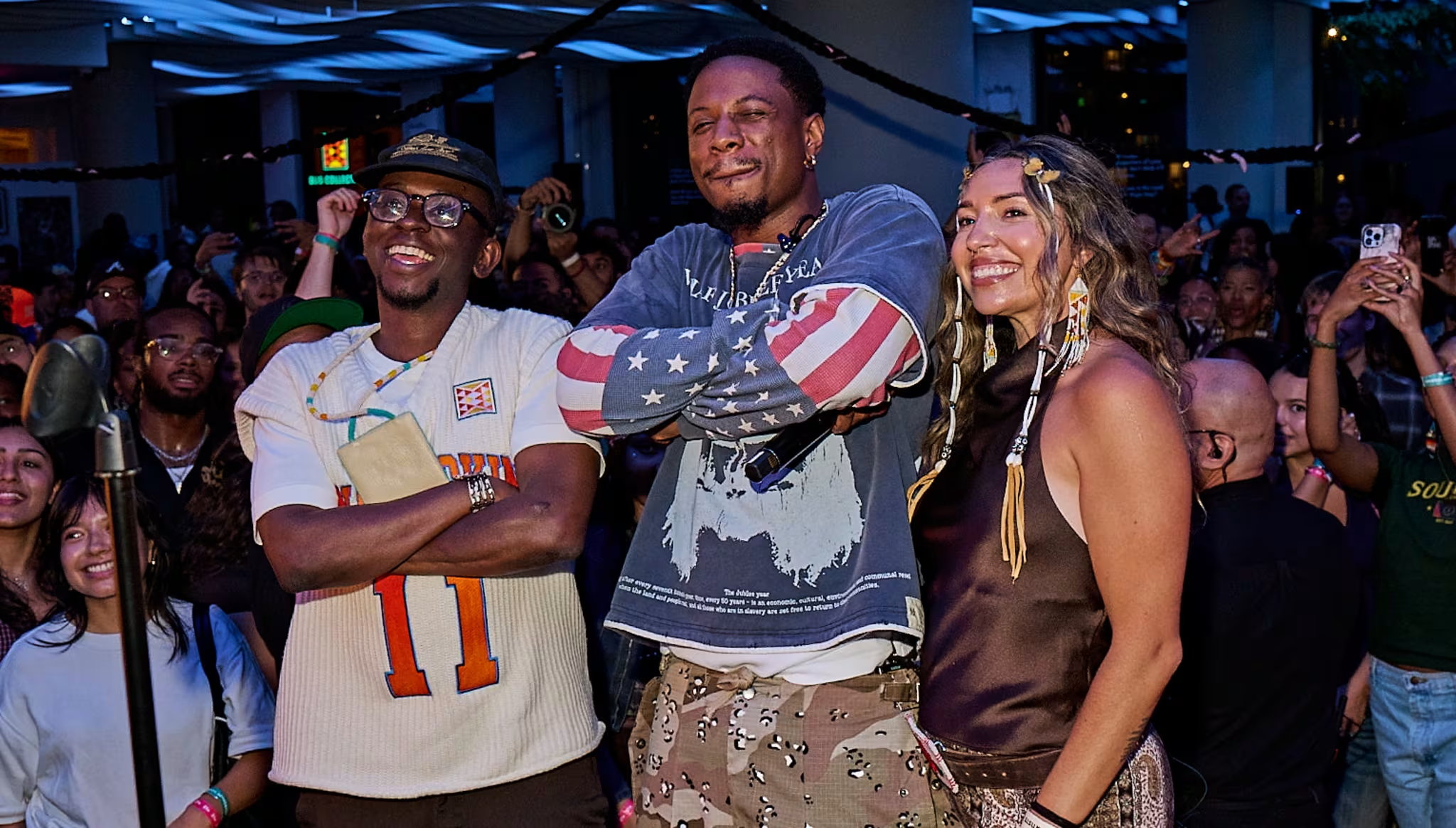
"Reclamation Day: A Reunion of Hope" was an immersive cultural gathering in Brooklyn that blended music, art, activism, and storytelling while centering the Black and Indigenous histories that are often left out of traditional narratives. Organized by the BLIS Collective (Black Liberation Indigenous Sovereignty), the event guided attendees through three experiential zones (Reclaim, Repair, and Reimagine) before culminating with a performance from Joey Bada$$.
The artist spoke with Complex that day, and when asked what word comes to mind when he thinks about America at 250 years old, Joey didn't hesitate.
"Corrupt," he said. "Two hundred and fifty years is really not a long time when you think about a country."
For Joey, the event was ultimately about confronting history honestly.
"I think America needs to see its history," he said. "Not the written history, the true history."
The Brooklyn rapper said participating was an easy decision, citing Nina Simone's belief that artists have a responsibility to reflect the times.
"One of my favorite quotes is Nina Simone," he said. "She said that all artists have a responsibility. We got a responsibility to report at the times, what's going on. So when I see something like this, it's a no-brainer. Plus, it's in Brooklyn."
That hometown connection was one reason BLIS co-founder Trevor Smith said Joey was the perfect headliner. Smith pointed to ALL-AMERIKKKAN BADA$$ and songs like "Land of the Free" as examples of the same reframing Reclamation Day hoped to inspire.
"We're really trying to twist and reframe the narrative of the United States, and he did that in his art," Smith said.
Joey also toured the installations before the event and said several pieces immediately stood out.
"I'm a big art collector," he said. "There were a couple pieces that caught my eye. I'm gonna see if I can leave home with them tonight."
For BLIS co-founders Smith and Savannah Romero, the gathering was never about rejecting America, but expanding the story Americans tell about it.
"America is celebrating its quote-unquote 250th celebration, but we know the history of this land extends far beyond just 250 years," Romero said. "We thought it was important to provide an alternative that was telling a truer, more authentic, nuanced story."
She added that conversations about American history often force people into extremes. "I think it's okay for us to strive towards something better," she said. "It's okay for us to acknowledge all of the places where we've gone wrong as a country and be very, very honest about the harm that has been done."
Smith said one of the biggest misconceptions is that many Americans still don't understand the scale of violence Indigenous communities experienced. "I don't think people truly understand the attempted genocide and mass murder that happened on these lands," he said.
Rather than organize a traditional rally or protest, BLIS intentionally built Reclamation Day around culture. "Not everybody wants to pull up to a rally. Not everybody wants to pull up to a protest," Smith said. "But the majority of people listen to music. The majority of people will come to a function. And then they're met with these narratives about reparations and Land Back."
Joey agreed that artists still have an important role to play, though he acknowledged that responsibility isn't for everyone. "I do think artists have a responsibility to speak out, but I don't think it's on every artist to speak out," he said. "Artists who really take the art seriously and are intentional with their messaging, absolutely."
He also said his own activism has evolved.
"When I was younger, I definitely would go to the protests," Joey said. "Now I think we need to protest in different ways. We got to protest with our capital because this is a capitalist country. That's the language that they speak."
Asked what he would rewrite about America's history, Joey pointed to the country's founding.
"It would be that the country was founded by the people who were originally here first. The Indigenous people. Not the colonizers."
Still, he hopes people who leave events like Reclamation Day come away with something bigger than politics. "I would hope that they walk away with the idea that unity is still very much present today," he said. "Sometimes it's just a matter of finding the right spaces."
Looking ahead, Joey said he hopes his work becomes "an intellectual safe space" that encourages people to think independently rather than follow the status quo.
"In 25 years," Romero said, "people can look back and say, remember Reclamation Day when reparations and Land Back weren't realized? But now they are."