Key Takeaways
- JAŸ-Z In 8 pairs Jay-Z with Rick Rubin for a candid, eight-episode tour through more than 25 songs from his 30-year career.
- Hov revisits his bond with The Notorious B.I.G. before his death, the roots of his Nas rivalry, his complicated relationship with Ye, and the painful family history behind songs like “4:44” and “Legacy.”
- Across all eight episodes, he also unpacks favorite bars, studio habits, career regrets, Beyoncé’s fearless recording style, and the street-to-boardroom journey that shaped his music and legacy.
"Let's step into the light."
These words, from music producer turned quasi content creator, Rick Rubin, are the first thing you hear in JAŸ-Z In 8, a new eight-part docuseries premiering on HBO Max on Friday, September 18.
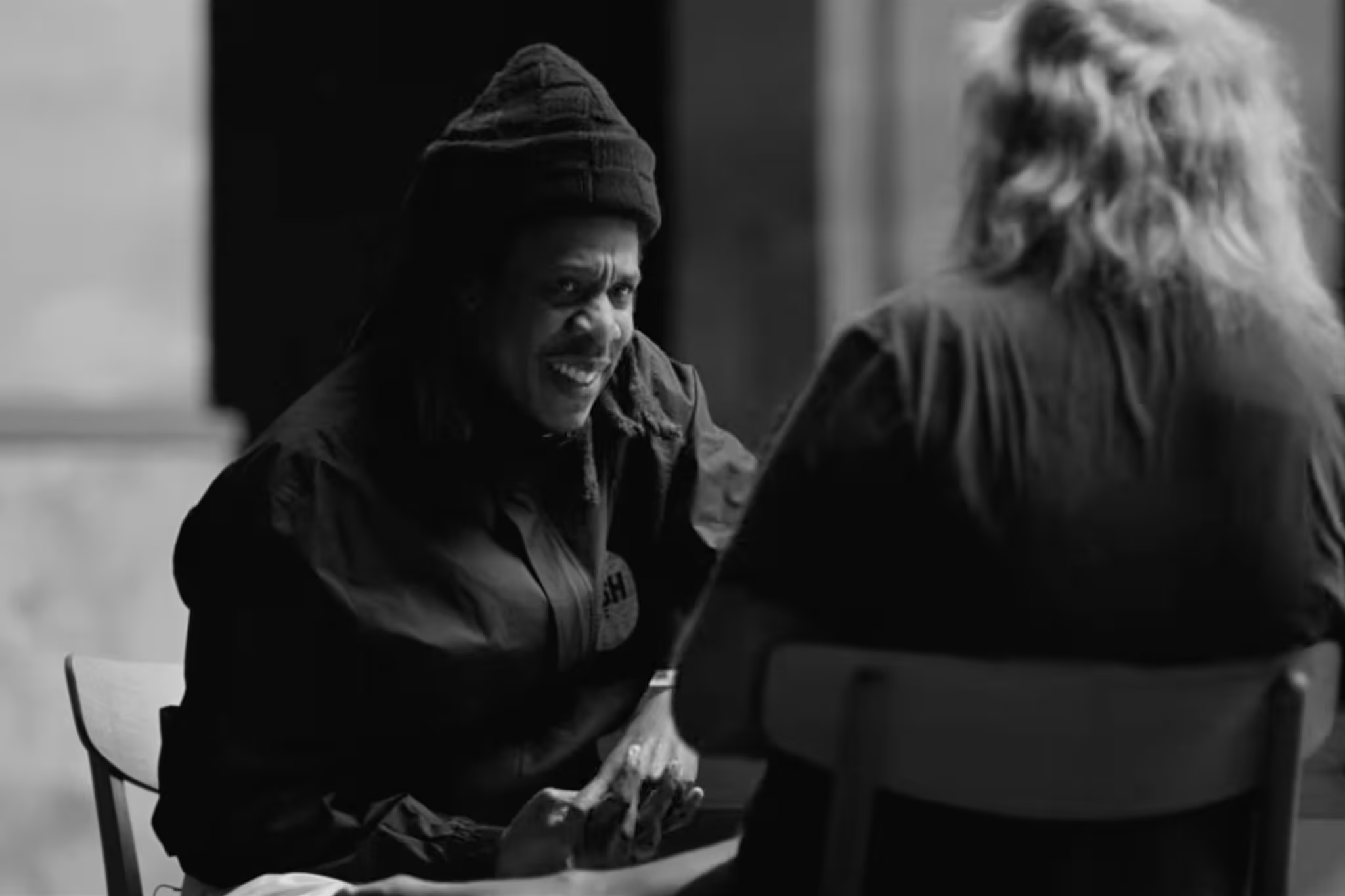
It's called a "docuseries," but it's really more of a podcast. The entire series, which spans more than seven hours and will air two episodes every Friday for four weeks, features the music legend at a table with Rubin, who not only is the director but plays the role of layman's guide for the audience while Hov does the reflecting.


Guiding the conversation is Jay-Z's catalog—the two run through over 25 songs from his 30-year career. There are some songs you'd expect to find, like "Where I'm From," "Can't Knock the Hustle," and "99 Problems." But there are also some true wildcards, including "Don't You Know"—a real deep cut from the Paid in Full soundtrack—and Kanye West's Donda track "Jail."
Outside of music he's released, this is the most personal we've seen Jay, who weaves tales from his childhood with philosophical musings about transitioning from the streets to corporate living and Genius-level breakdowns of his famous lines. Yes, there are cringe moments; like when Jay over-explains a pretty obvious verse or metaphor, or when he takes a couple of beats to define "no cap" or explains what food stamps are.
But this is a mostly rewarding series, one that works best when Hov gets out of motivational guru mode and starts telling stories—like being in the studio with Scarface when he recorded his memorable "Can't Be Life" verse, or hanging out with The Notorious B.I.G. before he died, or the real-life story that made up the final verse of "Allure."
With the series ongoing, here are the most interesting things we learned from episode three and four of JAŸ-Z In 8.
Shop the Jay-Z Collection on Complex
Episode 1
The Dynasty intro is Jay’s favorite intro
Fittingly, the first song they play is The Dynasty intro, which many Jay-Z fans consider the best opening song of his career. You know who agrees? Hov himself—who, in the midst of explaining the messaging, casually admits it's his favorite of his intros.
The conversation around this song starts the series well; Hov is game to break down the track, and he features a mix of generally cool details—like how the "psalm" line is a reference to Biggie and Junior M.A.F.I.A., who all had the same religious scripture tattooed on their arms—and funny quips, like when he mentioned he wore durags at this time, despite the fact he didn't have waves.
The first rap record Jay-Z heard was “King Tim III (Personality Jock)”
In the first episode, Jay really broke down his mother Gloria Carter’s love for music and how it affected him. He mentioned that her massive record collection was easily the most valuable thing they had in their house. But also that their home was the hub for good times. "Everyone would come to our house to party ... I remember our house being a house of sports and music," he said at one point.
One cool deet was when Jay talked about the first time he heard a rap song: it was the Fatback Band's "King Tim III (Personality Jock)," which was released a couple of months before Sugarhill Gang's "Rapper's Delight" came out. This was a record that, of course, his mother owned.
He realized rap could be a business when he saw Jaz-O collect a $400,000 check
Jay-Z started rapping and writing when he was nine years old.
As he got older, and started to hit the streets, going out to Trenton, New Jersey to hustle, making raps got deprioritized. But even before he left for Trenton, he had already met Jaz-O, a talented rapper from his projects, Marcy, who was making noise—so much so that by '88 he got a recording contract. Jay talks about seeing the business potential in rap when Jaz-O signed a recording contract for $400,000 with EMI. "When he told me, I was like, 'What? $400,000 to do this, to rap?'" He put that kind of money in proper context when he said, "There's legends in the streets that people celebrate for being kingpins that never seen $400,000 ... for sure."
Jay-Z wanted to drop one album and then become a businessman
Jay speaks about those early years of being a rapper. He says he almost had to hide the fact that he wanted to rap, saying, "Rappers were pulling up in turtle tops and minivans, and we was coming with 4Runners and Lexuses and Acuras. You want to do that? We already doing this? That seems like a step backwards."
But the more telling part is how he viewed his own artistic career. It was well known he wanted to drop Reasonable Doubt and quit. But here he admits he hated being an artist, and that his goal was to one-and-done it and then become a "Russell Simmons" type, saying, "I didn't love being an artist ... I didn't like shooting videos, didn't like doing interviews. I didn't like speaking."
Obviously, he'd change his mind—and, you know what, thank God he did.
He always waits until the last minute to rehearse
Talking through his process, Jay locked into how his live show changed over the years; he admits that after the Unplugged show with the Roots in 2001, he never went back to performing with a DJ and would only do shows with a live band from then on. But he's also particular about prep; Jay claims that you're typically supposed to start rehearsing a month out from a show, but he always saves it for the last minute, saying, "If I know it too much, I check out—my mind wanders." He added that for Unplugged, the first time they rehearsed was the day before the performance.
Episode 2
Jay has regrets about how he rolled out The Black Album
Rick starts off the second episode of the docuseries by playing "What More Can I Say," which gets Jay reminiscing about The Black Album. In particular, Jay can't believe they didn't make "Encore" the first single and "What More Can I Say" the album closer. Jay talks about music executive Kevin Liles and engineer Young Guru's less-than-rapturous response to "Encore," which put a seed of doubt in his mind—so that by the time he's ready to give Funkmaster Flex music to play, he only gives him "P.S.A.," not "P.S.A." and "Encore" like he'd planned. The first single from The Black Album ended up, of course, being the Neptunes-produced "Change Clothes." That song was a top-10 hit ... so everything worked out for the best.
Jay-Z cut a line about California Biggie had in "Brooklyn's Finest"
Really the best part of episode two focuses on Jay's relationship with Biggie and how it developed.
Jay talks about the two of them really clicking after recording "Brooklyn's Finest"—going to see The Kings of Comedy together afterward, Biggie wanting them to both move to Atlanta and get houses together, and the jokes the two shared.
Jay actually talked very granularly about the making of "Brooklyn's Finest," from the rap patterns to how the beat came about—it started when Jay was riding around listening to Ohio Players’ “Ecstasy” and had Dame tell Clark Kent to cut it up. According to Jay, Biggie originally had a line in his verse — "I'm warning ya, most hated in Carolina" — that Jay cut because he didn't want to get caught up in the East Coast/West Coast beef.
He would do this "freeplay" session to get bars off
Jay also talked about what inspired "What More Can I Say." The song famously features the rapper rhyming until the beat gives out. It came out of a ritual he used to do where he'd put a beat on, everyone would run to the studio to watch, and Jay would dump all the rhymes stuck in his head that no one had heard. They called it "Freeplay," and Jay would often have so many raps, and rap so much, that the beat would cut off and he would still be spitting. Does anyone have video of one of these?
Episode 3
He hasn't listened to "4:44" since he made it
Episode three centers on some of Jay-Z's most emotional songs from across his career, from "You Must Love Me" to "This Can't Be Life" to the title track of 4:44.
That last one is widely read as an apology to Beyoncé, and it's an unflinching look at his shortcomings as a husband. It's also a song Jay can barely stand to hear. He reveals that he hasn't listened to it since he made it, nearly a decade ago, and says it and "You Must Love Me" are the two songs in his catalog he returns to least.
The hardest part for him is the final verse, where he imagines his children one day learning about his infidelity.
"It's so raw, and so honest… the last verse, you're dealing with your children… And the day they're going to hear this, they're going to grow up. They're going to hear this," he said.
Jay says he was “a hustler, not a gangsta”
Episode three starts on a heavy note.
The first song they go over is the In My Lifetime, Vol. 1 standout "You Must Love Me," the most personal record in Jay-Z's early catalog, in which he tells three stories about loved ones he did wrong.
The second verse centers on a confrontation with his older brother, who was getting high and had stolen his ring. Jay shot him in the arm. While talking about the song, Jay reveals that there was a girl in the room, which only intensified the situation.
"This is my big brother… he stole the ring in front of the girl… it just kept escalating."
What's more interesting is what he says next. Jay sees the moment as out of character. Despite being from the streets, he never considered himself violent. As he put it: "All my years of hustling, I always stayed away from violence. I was a hustler, not a gangsta. There's a big difference. I didn't want to hurt nobody, I didn't want to embarrass anybody, I didn't want to bully anybody. I hate bullies. But I would fight… I wouldn't allow myself to be bullied at all."
Jay is really proud of the “Jigga Man is diesel when I lift the eight up” line on “Breathe Easy”
One of the most fascinating parts of the series is catching the little moments when Jay's energy lifts and he gets genuinely excited about a topic. The best example comes in episode three, when they get to "Breathe Easy (Lyrical Exercise)”, a hidden track on The Blueprint. It's a song so slept-on that Jay himself left it off the setlist at his Blueprint show at Yankee Stadium. And yet it's home to one of his favorite double entendres.
While listening, Jay tells Rick, "This is my favorite line," then promises to explain once the song ends. When it does, he's damn near giddy breaking down the line. On one level, it's about being strong enough to lift a gun. On the other, it's a nod to Shaquille "Shaq Diesel" O'Neal hoisting Kobe Bryant, who wore No. 8, after the Lakers won the championship.
It's not the hardest line to decode—which makes his reaction so revealing: Jay just loves a good slick line.
Episode 4
Jay only met his father one time as an adult
For a rapper who's famously guarded, we know a surprising amount about Jay-Z's troubled relationship with his father, who left when Jay was a child and was absent for most of his life. It's a wound he's returned to on record again and again, most famously on "Where Have You Been" and “Still Got Love For You.”
Episode four opens with him talking about his dad. Around the time of The Black Album, Jay's mother, Gloria Carter, tells him he needs to meet his father. Jay resists at first but eventually gives in. The day comes, and his father never shows. Some time passes, and his mother comes to him again with the same message: you need to meet your dad. This time his father, AJ, shows up, and the two have a long conversation in which they patch things up.
What Jay didn't know was that his father was sick, and that it would be the only time he'd meet him as an adult. He died about a month later. More heartbreaking still, it was Jay's sister Annie who found him. Looking back, Jay says he's grateful they had even that one conversation.
"I know if I had not spoken to him, oh, forget it… I don't know what happens… I don't know where I go."
He adds that his mother understood exactly what was at stake: that if his father "had passed without a conversation, I would never recover."
Jay treated the studio like a 2-10 job
While discussing "Where Have You Been" and the Dynasty sessions, Jay broke down his studio habits. As he told it, he was never the night owl most rappers tend to be. He'd get to the studio around 2 or 3 p.m., with his longtime engineer Young Guru already there waiting, and he'd leave around 10. When asked if he ever worked late, Jay said:
"Very rarely. If I get an idea that I can't let go, I'll go till the next morning… it's not normal to me."
Jay was wearing a bulletproof vest in the "Streets Is Watching" era because he "was in a full-blown war"
Episode four dug into Jay's transition from the streets to fame. Reasonable Doubt, his proper debut, dropped in 1996 and launched him into a new career, one that brought new stressors, especially in dealing with people from his old life. As he put it: "I haven't changed. In one year, everything changed, the way they talked about me, the way they viewed me. Everything's changed."
That tension carried over into In My Lifetime, an album Jay described as paranoid, a feeling that comes through most clearly on songs like "Where I'm From" and "Streets Is Watching."
One of the defining images of that era comes from the "Streets Is Watching" video, and the cover of the soundtrack of the same name, where Jay is seen in a bulletproof vest and a Rolex. The look was so memorable that he recreated it on stage at Yankee Stadium. But as Jay explained, the getup wasn't a costume. He really was wearing that vest for protection.
"That's how I came to the shoot… I just got here and the photographer was like, 'You look great, let's shoot it.' But I was in a war. I had a vest on… for a reason. I was in a war."
Episode 5
Jay feels like he never figured out the “Young Forever” beat
In episode 5, Rick asked Jay-Z if there was ever a beat he loved but couldn’t “crack.” Jay gave one specific example: the Blueprint 3 track “Young Forever.” He said he liked how the drums contrasted with the sample Kanye flipped, Alphaville’s “Forever Young.” “I never cracked it,” Jay said. “Still, to this day, when I hear that song, I’m like, ugh.”
He settles the “water to a well/whale” debate on “U Don’t Know”
“For years it was this whole thing, is he saying well or whale. Because they both work. Obviously I’m saying both… My joy as a writer is to try and make things work on multiple levels,” Jay said.
There’s a lost Jay-Z and Rick Rubin collab built on Chuck D lyrics
After the two listen to the Reasonable Doubt standout “Politics as Usual,” Jay brings up a song he recorded with Rubin.
He doesn’t just mention it. He raps a verse—which borrows from Public Enemy’s Fear of a Black Planet masterpiece “Welcome to the Terrordome”: “I got so much trouble on my mind / Refuse to lose, and my nephews need new shoes,” Jay raps flawlessly. Rick mutters, “I can’t believe you remember that.”
Episode 6
Jay and Ye Argued Over the “Red Cap” Line on “Jail”
The most recent song covered in the docuseries is “Jail,” Jay-Z and Ye’s last collaboration, from 2021’s Donda. On the track, Jay declares this might be the return of the throne, but it could also stand as an endpoint for the two, whose relationship has only grown more strained since.
Jay reveals that the line “Stop all of that red cap, we goin’ home,” a reference to Ye’s embrace of Donald Trump, sparked a back-and-forth. Ye asked him to change it. Jay stood firm. “I was like, ‘Sorry, I ain’t gonna change it. It’s how I feel,’” he said. He also told Ye, “You should probably take the verse off if you feel strongly enough about it. This is your project… everything on it should be the way you want it to be.”
Still, Jay still spoken somewhat warmly of Ye, calling him “one of the most brilliant creatives we’re ever going to see.” “No matter what, he’s always... had this space for me and this reverence as his big brother,” Jay says. “Obviously he does his things... but I know he hasn’t lost that feeling.”
Jay-Z Says He Was Briefly Blackballed by Hot 97
Jay has had plenty of legendary moments with Hot 97 over the years, from multiple Summer Jam appearances to classic freestyles. But while discussing “99 Problems,” he explained that his line about radio not playing his records was aimed at the station, which tried to freeze him out after he supported rival Power 105.
Jay acknowledged that Hot 97 couldn’t fully blackball him because he was too beloved in New York. Instead, the station played his old songs and skipped the new ones. It wasn’t sustainable. “That didn’t last long, ’cause I stood my ground,” Jay said.
Goodfellas Inspired “Threat”
“I’m especially Joe Pesci with it, friend I will kill you, commit suicide, and kill you again” closes out “Threat,” a line that’s menacing and slyly funny at once. Jay said Pesci’s turn as Tommy DeVito in Martin Scorsese’s Goodfellas was a major inspiration for the song, pointing to the scene where Tommy insults Billy Batts, played by Frank Vincent.
“It was just such a great scene, and [‘Threat’] was based on that,” he said. “Gangsters are hilarious… the way they see life is really funny. People think a gangster is this brute who doesn’t speak or doesn’t know how to speak… To create a business like the ones that have been created, you have to be intelligent. You just use your intelligence in a different way.”
Episode 7
Hearing a young Big Daddy Kane in a cypher made Jay realize he wasn’t there yet
In episode 7, Jay revisited his early years.
In one of the more illuminating stories, he recalls Jaz-O bringing a young Jay to a cypher where Big Daddy Kane, ahead of his debut, was rapping. Kane spit “So put a quarter in your ass ’cause ya played yourself/ Like a game in the arcade”—a bar that would later surface on Marley Marl’s Juice Crew posse cut “The Symphony.”
Jay was stunned. “‘You played yourself’ wasn’t a popular phrase yet, and I was like, ‘Wow,’” Jay said. “I was in there thinking, ‘I got a ways to go.’ I’m not there yet.”
Jay called Kanye “entitled” over the Chris Martin line on “Big Brother”
“Big Brother” was the first public sign that Kanye and Jay’s relationship was more complicated than it looked.
One of its most quoted moments is Ye’s claim that he told Jay about his Coldplay collab, only for Jay to land Chris Martin on “Beach Chair” first: “I told Jay I did a song with Coldplay/Next thing I know he got a song with Coldplay/Back in my mind, I'm like, ‘Damn, no way’”
Years later, it clearly still doesn’t sit right.
Unprompted, Jay brings up the line, explaining that he was friends with Chris Martin first and was the one that introduced the Coldplay singer to Ye. “The world hears that and takes it like, ‘Jay [is] foul.’”
Nas skipping Reasonable Doubt sessions really did start their beef
Of course Nas came up.
Near the end of the seventh episode, Jay gets into one of rap’s defining rivalries, and he says it started with Nas no-showing a Reasonable Doubt session.
“Nas was supposed to be on my first album; he just never showed up to the studio,” Jay said. “And I’m not really a guy like that… so that was that for me. I’m never asking him for anything again. [There’s] not a problem. But that was the end of it.”
Reasonable Doubt and It Was Written famously arrived about a week apart in 1996, and the latter opens with “The Message,” featuring Nas’ “Lex with TV sets—the minimum” bar, which Jay remains “99 percent sure” was aimed at him.
Jay, who says the two are close now, also admired how Nas rose to the occasion, given that Jay was on a hot streak and Nas had been inconsistent. “It fizzled out at the end; during the whole thing we had so much respect for each other,” he said. “It got personal… but it was more about competition.”
Beyoncé works very differently in the studio
One of the throughlines of the series is Jay trying to drop the mask of cool he built over the years and let himself be vulnerable.
That doesn’t seem to be a problem for Beyoncé. It comes through when Jay compares how the two of them record. He describes Bey as “wild,” someone who’ll try anything in the booth, something he admits he’s still too self-conscious to do.
“Her creativity, a lot of it is in the melodies and the harmonies… and she’ll try anything,” Jay said. “[I’m like], ‘Damn, I wish I could do that.’ I would be too self-conscious.”
Episode 8
Like every dude, he took lessons from The Godfather
Episode 8 is focused on legacy and the foundation Jay has built for his family, so there are fewer studio or street stories than usual. There are still some good tidbits.
Throughout the series, and his catalog, Jay keeps coming back to movies, especially the classic mob films Gen X and aging millennials grew up on. While breaking down 4:44’s “Family Feud,” he digs into the line “A man that don't take care his family can't be rich/I'll watch Godfather, I miss that whole shit” a nod to Vito Corleone.
He says that for years he missed one of the film’s key lessons: Sonny, the hotheaded brother, gets killed for it. Only after rewatching it did he realize how much of Sonny’s issues was self-inflicted. It’s a great moment, Jay in full film-nerd mode, connecting a movie he loves back to his music.
His grandfather had a dark history
The heaviest moment of the episode comes when Jay reveals that his grandfather, a preacher, fathered a child with his own daughter.
Jay alludes to it on 4:44’s “Legacy.” He says it was an open secret in the family and that he learned about it around the Black Album era. “It just broke the family apart,” he said.
Still, he finds some empathy. He reflects on how cursed it must be to have the gift of reaching people through religion while carrying such troubled thoughts in the same mind.