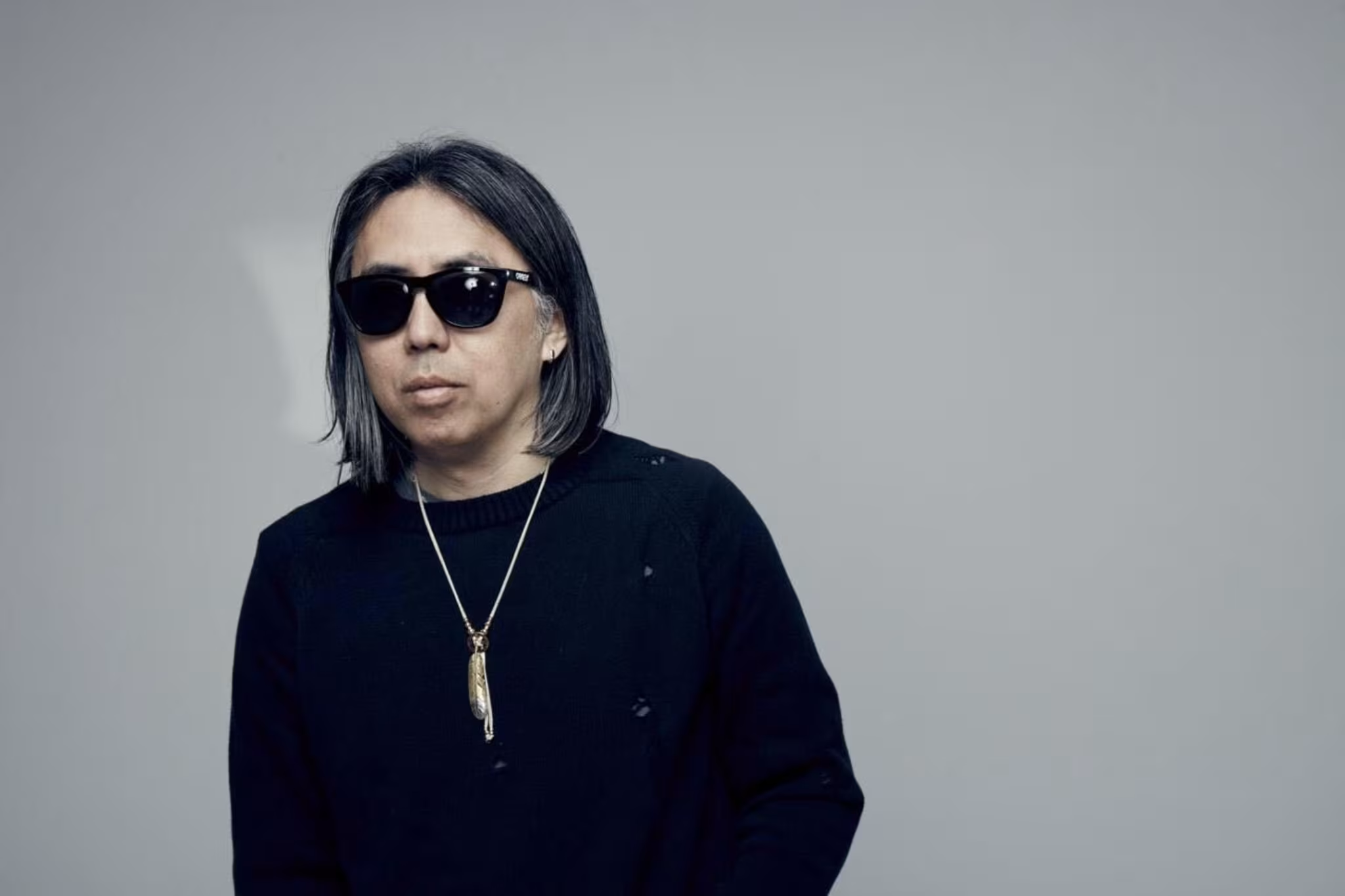
Hiroshi Fujiwara has worked with Nike, Louis Vuitton, Levi's, and Starbucks. His double lightning bolt has landed on the Air Jordan 1, BE@RBRICK, and just about everything in between. But ask him to describe Fragment, the studio behind all of it, and he'll tell you it isn't a brand.
"Fragment is not a brand," Fujiwara tells Complex. "Sometimes I design clothing, sometimes a product, sometimes it's a space. I think Fragment is simply a way for me to work on things I find interesting."
This year, one of those spaces is ComplexCon.
Tickets for ComplexCon Available Now.
For the festival's 10th anniversary, taking place Oct. 3 and 4 at the Los Angeles Convention Center, Fujiwara is serving as artistic directors alongside Playboi Carti. It puts the man widely credited as the godfather of streetwear in a lineage of ComplexCon artistic directors that includes Takashi Murakami, Travis Scott, and Daniel Arsham.
"I've been involved with ComplexCon in different ways over the years, so the timing felt right when they offered me the role," says Fujiwara. "Ten years is a decade, a good stopping point where you can look back and also look ahead to what comes next."
Hiroshi Fujiwara's Artistic Direction for ComplexCon 2026
Fujiwara's vision for the anniversary is a departure from what longtime attendees are used to, and that’s on purpose.
"I wanted to create a space with a more toned-down and sophisticated atmosphere than the usual ComplexCon," he says. "A little bit darker, and the concept was also to play with reflection. I think the Complex team did a great job bringing it to life."
It's not the first time he's left a mark on the event. In 2017, Fujiwara sat down with Jeff Staple in Long Beach for “The Art of Collab,” a ComplexCon(versations) panel where he broke down his history of collaborations, including HTM, his Nike project with Mark Parker and Tinker Hatfield.
How Hiroshi Fujiwara's DJ Background Shapes His Design
Long before the lightning bolt, Fujiwara was a DJ. He came up in Tokyo's Harajuku scene in the 1980s, and he says the way he works today still traces back to the decks, "maybe without realizing it."
"DJing is more about selection. You don't make every record yourself. You choose songs and play them together," he says. "I like the unexpected outcomes that come from mixing different things from different eras. It sometimes leads to something you didn't expect."
That's the Fragment playbook in a sentence. "A lot of what I do is editing and rearranging things that already exist, but not many people realize that changing something just a tiny bit can make a big difference."
Music is still a big part of Fujiwara’s life, though the hunt has changed. "There is so much music now, and you can discover new songs anywhere from your phone. I come across so many good artists now that it's hard to keep up," he says. "But I also miss the challenge of discovering something I love. You had to go somewhere (a club, a record shop, a certain neighborhood) to find something. The communities. I feel that music and fashion were more closely connected because of that."
His verdict on the shift: "It's different, not necessarily better or worse."
Fragment's ComplexCon Collabs: Pokémon, Dodgers, Disney, and More
Fragment has never manufactured its own products. Its identity lives entirely in collaborations, and Fujiwara's approach to them is simple.
"My perspective is that a lot of products that exist today are already perfectly designed. Sometimes, though, imperfection is better than perfection," he says. "Everything I design is my own reinterpretation. A very small twist is often enough."
He brought the same mindset to ComplexCon, where Fragment is dropping collaborations with Pokémon, the Los Angeles Dodgers, Disney, MEDICOM TOY BE@RBRICK, BRABUS, Ray-Ban, and WEEKEND SEQUEL.
For someone whose work has shaped streetwear for decades, Fujiwara is surprisingly unbothered by the idea of legacy. It all started, he says, with wanting to make some T-shirts he and his friends could wear.
"One thing I've stayed true to is only making things that I like. I design for myself, based on what I want and what I like," he says. "Some projects work, some might not do so well. That's okay. I think continuing to be curious and making what you like is more important."
Hiroshi Fujiwara on Nike HTM and His Air Jordan 1 Collabs With Travis Scott and Union
Fujiwara’s relationship with Nike spans over two decades. In 2002, he teamed up with Mark Parker and Tinker Hatfield on HTM, a series that experimented with premium takes on silhouettes like the Air Force 1 and Air Woven.
"HTM was a small project that Mark, Tinker, and I started," he says. "Nike had incredible technology and knowledge of sneakers, and I could bring a different perspective from outside."
He's modest about what it set in motion. "If HTM helped show that someone from outside a company could have a meaningful role in product development, then I think that was important, and I would be happy about that. But back then, we weren't thinking about it that way. We were just having fun experimenting with new ideas."
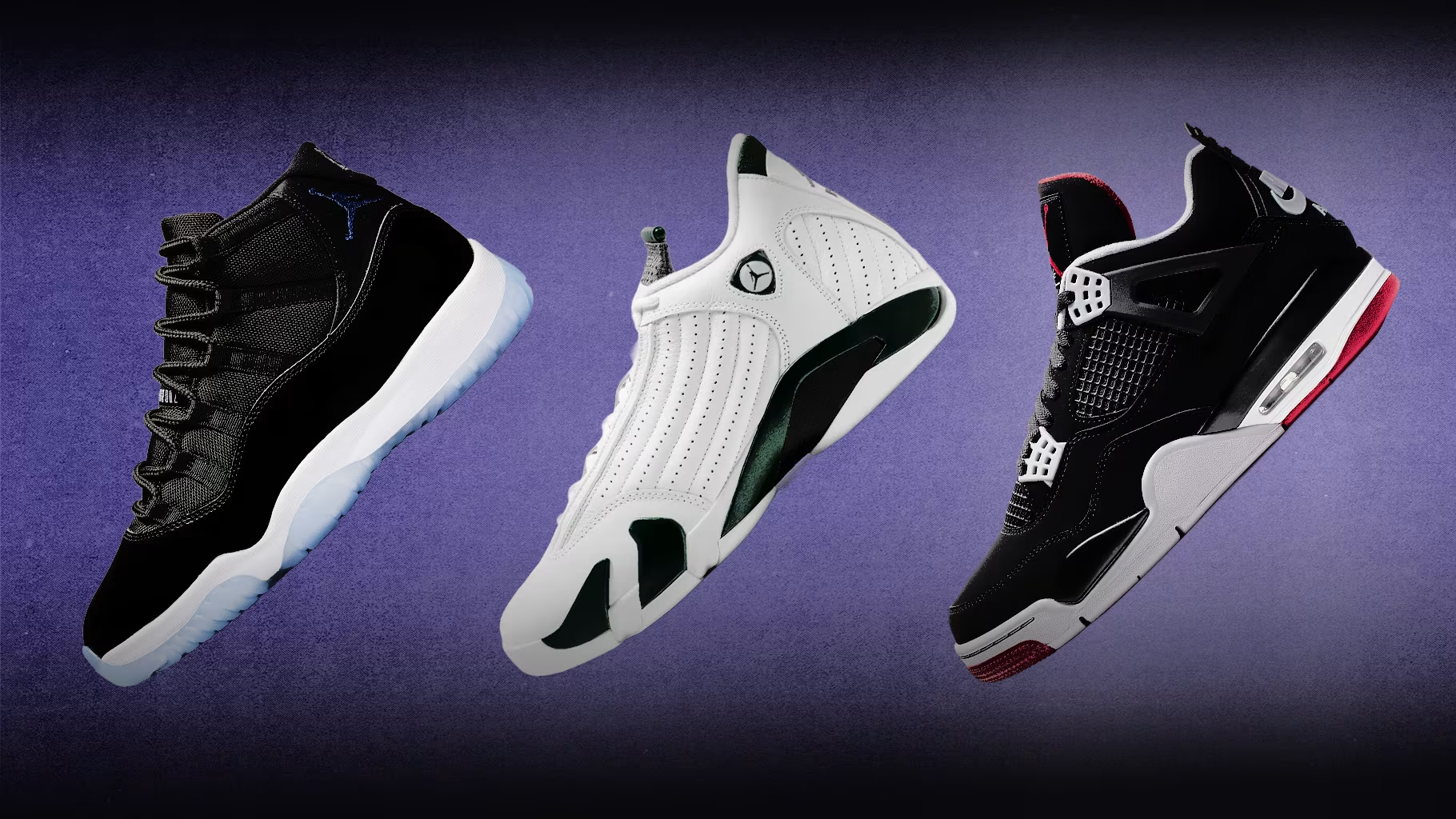
Lately, Fragment has also leaned into three-way projects, from the Travis Scott x Fragment x Air Jordan 1 in 2021 to this year's Union Los Angeles x Fragment x Air Jordan 1. But Fujiwara admits the format isn't usually his thing.
"To be honest, I'm usually not as interested in three-way collaborations because it can be difficult to find the right balance in the design," he says. "But it can also be a lot of fun if you do it with your friends, and I would only do it if it makes sense. In the end, it can create something very unique by bringing together different identities."
Hiroshi Fujiwara on Gen Z, AI, and the Future of Retail
Travel shaped Fujiwara's career early on, when seeing something meant physically being there. These days, he says, the internet has changed what a trip means, but he still seeks out places he's never been. One that stuck with him: Tbilisi, Georgia, where he attended fashion week. "I felt so much energy and passion from the younger generation there."
On youth culture in 2026, he's more curious than critical. "The younger generation lives in a completely different era because of the evolution of technology," he says. "Today they have access to so much information, especially with AI, and I'm looking forward to seeing what they do with it creatively."
And on retail, he sees the pendulum swinging back. "Everything shifted online, and now things are shifting back offline, which makes the retail experience interesting again," he says. "A shop can be a place to meet people, hear music, see something unexpected, or experience something that doesn't translate to a screen. Like it used to be."
For one weekend in Los Angeles, that's exactly what he's building.