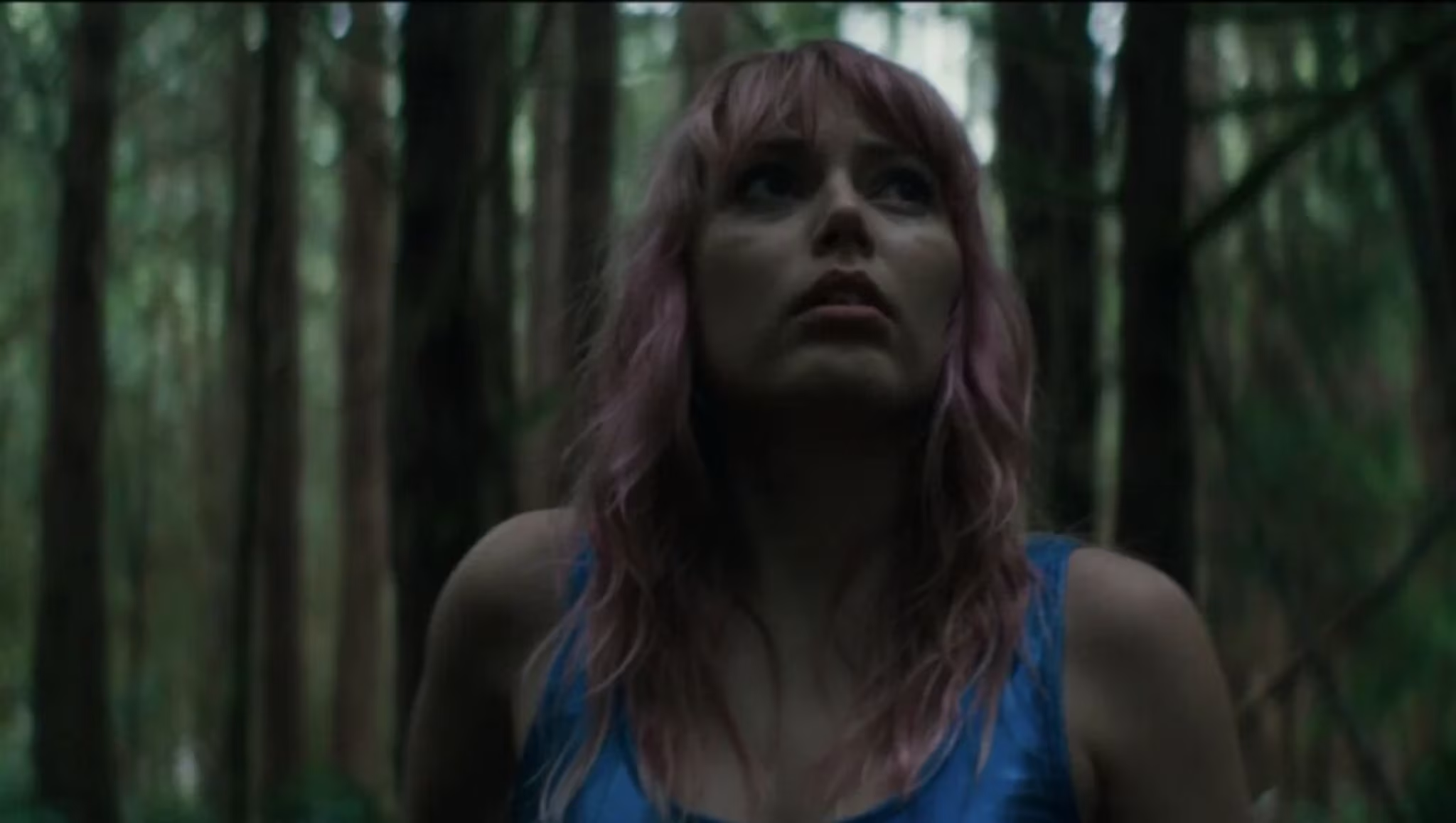
Since 2005, Austin’s Fantastic Fest has been a beacon for makers and lovers of horror, science fiction, fantasy, and other varieties of cult films. For their 2026 edition’s closing film, the Fest selected The Swallow, which is written and directed by Kevin Kölsch and Dennis Widmyer (Starry Eyes, the Pet Sematary remake) and stars Grave Van Dien (Stranger Things, Redux Redux) as Ziggy, a woman who goes on a trip with a group of friends to a secluded part of the woods, encountering a batch of ferocious, unrelenting…mud.
Yes, this becomes “a horror film about mud.” Doesn’t sound scary? We imagine classics like The Blob mean nothing to you then? Never seen The Ruins? Whether it’s the classic 1950s horror from legends like Roger Corman or, what’s more on the nose, the B-movie horror craze of the 1980s, there’s something about the terrifying aspects of the things surrounding us that truly can stick with us.
There are some truly awesome visuals for fans of gnarly horror, even though the growing terror is literally on (in? of?) the ground. Without giving away anything, be ready from the moment The Swallow begins, and prepare for all kinds of spectacularly bloody moments; some awesomely gross scenes capture what the ‘80s B-movie horror wave was all about.
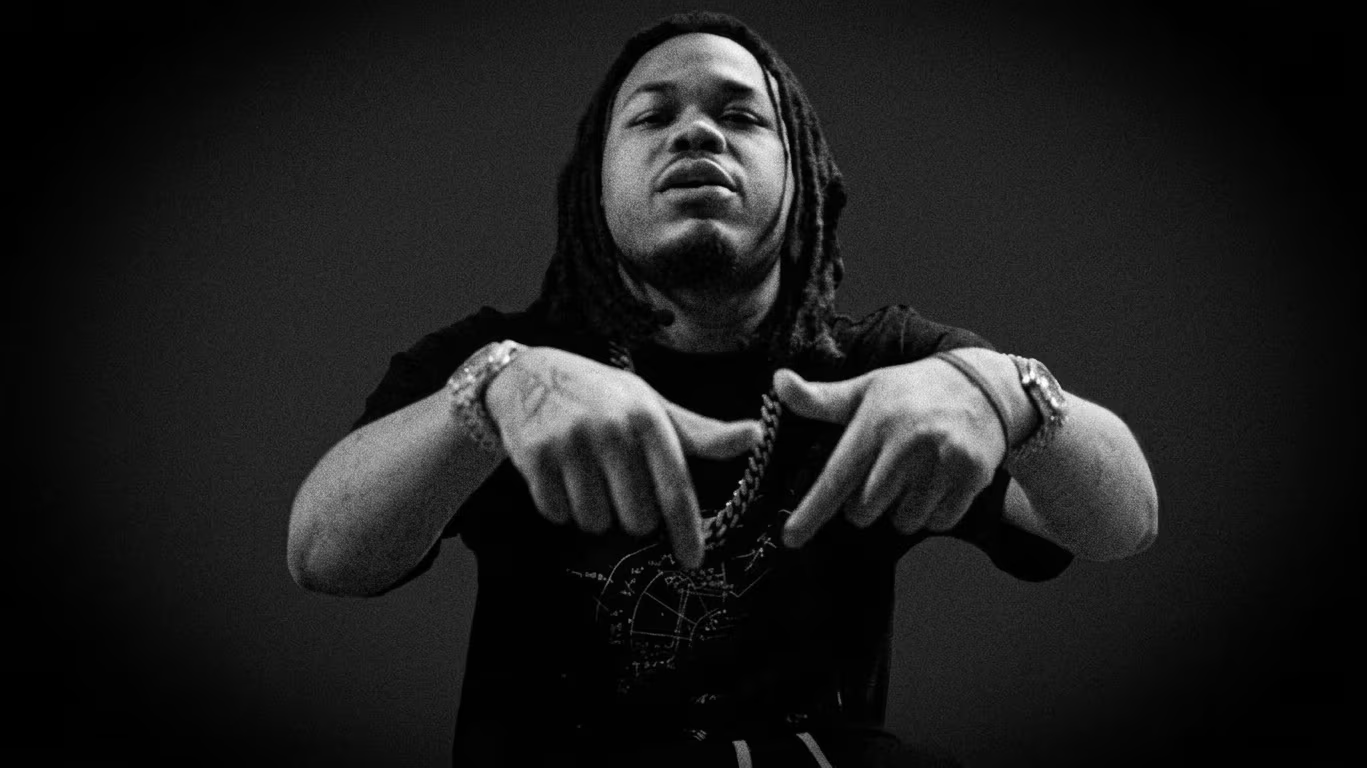
Funny enough, one of the more intriguing elements of this film’s dedication to ‘80s horror happens during the end credits: an original song that spoke to the film’s themes played over the credits, and The Swallow pulled that off, too, with Fatboi Sharif kicking some very mud-soaked verses. According to The Swallow producer Josh Goldbloom, “our composer Jonathan Snipes is in the band Clipping, with Daveed Diggs. He surprised us with this track; basically, Sharif spit lyrics over a beat, like a stream of consciousness, while watching the film.” For a film that truly speaks to the hardcore horror appreciators out there, it’s a dope touch.
Complex caught up with Kölsch, Widmyer, and Van Dien in the lull between their world premiere at Fantastic Fest and their upcoming screening at Beyond Fest on October 1 to discuss the making of this muddy horror movie.
Shop the Comics Collection on Complex
This conversation has been edited for length and clarity.
Earlier today, I took a walk after watching the film. I had to laugh because, after the Nor’Easter over the weekend, I saw some mud that brought me right back to the movie. Kevin, Dennis, that brings me to my first question: where does the idea, in particular, of mud that wants to consume you come from?
Kevin Kölsch: Well, there was a Nor'Easter…. [Everyone laughs]
Dennis Widmyer: Kevin and I had been playing the studio game, fortunately and unfortunately, for a couple years after Starry Eyes. And we were working on the sequel to that movie, Mama, that Andy Gushue directed that never came to be, but it was a great project, a great script. We were pretty into that one. But as always happens with any sort of studio project, is you get very fatigued over the course of several months from just over-analyzing everything and having all the executives debate stupid stuff like ghost logic. If Mama passes through a wall because she's an aberration, how is the hero going to break a chair over her back? You spend a week discussing that and got to put something in the script about it. And everything gets boiled down to mythology, lore, backstory. You need to have the characters to find a laptop or go to a library and pause the movie for 15 minutes while they do research.
And we were like, “how do we just come up with a very simple concept that almost plays an extended first act?” Something like Texas Chainsaw Massacre or something, where the whole movie's just pedal to the metal, and you're not ever pausing to do that stuff, which is fine. But we were like, “let's just try to show, don't tell, and see how long we could keep this going for.” And as it was, we could only keep it going for 82 minutes. But that was basically it. And then it was like, all right, that sounds easy, but it's not. Movies like Jaws, which I'm not comparing this to, are very hard to do. It's hard to make people just scared of something as simple as just the ocean.
And so we were like, what hasn't been done? There's that joke that you see all the time on Instagram nowadays, memes of quicksand and The Princess Bride and Lawrence of Arabia and Mad Max Beyond Thunderdome, people sinking in the quicksand. I even thought when I got older, quicksand was going to be a bigger issue, because in reality, quicksand doesn't actually really exist, at least not in the way that we see it in movies. And so we said, “what if we took something as simple as the earth, dirt, a puddle of mud, and made that scary?” So if you went camping, the next time you went camping or there was a Nor'Easter and you looked down and you saw a puddle of something, you would suddenly think twice about it. That was the mission statement that we set upon ourselves.
What was the timeframe for this? From concept to being able to say, “Grace, we want to put you in the film”?
Kölsch: There was a break in between. When we wrote the script, the script came pretty fast. It was lwas more of a “visceral experience” kind of movie over a “mythology” movie. We just banged it out in a just quick, fast draft. But then after that, this was actually something we were trying to get going back before the pandemic, and then the pandemic shut down all our projects. And then after the pandemic, people reached out about this one and said, "Hey, do you still have that script?" This one sort of lingered with people. We were like, "Oh yeah, we do." We were actually setting up with a different company than the one we made it with, but then the strikes actually fizzled those negotiations. And then after the strikes, another company reached out and said, "Hey, do you still have that script?" For some reason, this one resonated with people.
Hopefully it was because of that universal fear of people playing “the ground as lava” when they were kids and this being a concept that people can relate to. It's not very specific to one thing.
Grace, for you, what was your reaction?
Grace Van Dien: I'm obsessed with creature features. I see so many of them, and this is the closest non-creature creature feature I've ever read. And I loved Ziggy. I loved the name Ziggy. I loved her character. It just sounded like a lot of fun to do. And filming, it always feels like a summer camp experience, and this felt like the most summer camp experience I'd ever get filming anything.
Kölsch: That was mostly because we made her sleep in a tent. [Everyone laughs]
I was going to say, Grace, you're running through the woods, you're moving across logs. It's terrifying, but it really does feel like you were getting all of the summer camp activities in.
Van Dien: It was awesome. And it's cute. The filming process, a lot of times cast and crew and production, by the end of the week, everyone's tired of each other. You've just spent around 12 hours every day for the week with each other. You're not friends, you're not family, but we really did become that. And on Fridays we'd be like, "Y'all want to go get a beer?" And we would go get beer. It was really friendly.
Widmyer: And Tuesday too. And Mondays, Wednesdays. There was a lot of that. There you go. We always knew where to find everybody. [Laughs]
Grace, what were some of the hardest things you had to do?
Van Dien: I'm afraid of heights. So the tree sounded scary at first, but then once I was up there, I was like, "Wait, it's actually kind of cozy up here."
Kölsch: It's a big tree. I'll say that about Grace in general, and this is a credit to her, that most things that she came in with fears of, whether it was doing the height thing or going up on the fence or getting a squib, these were all things that even if Grace had any kind of hesitations about it, she never was not willing to do it. And usually after the first take, she was now really excited and going like, "Oh, let's do it again, again." Not just being in the tree, but even when you- [Ed Note: Best to leave the spoilers discussed here to the theater, when you can actually see The Swallow].
Well, speaking of some of the stuff that you guys put in there, there’s a scene where I was like, “Oh yeah, this is for me,” was when Rich pulls his arm back out of the mud. A vision like that, is that something that was in the script early?
Kölsch: Yeah, I think that's in a first draft, right?
Widmyer: Yeah, I think so. You know what it is? The script started off kind of thin, this quicksand and they sink. And then we were like, "Yeah, but what if it starts to burn?" And then we were like, "What if it starts to erode and eat the skin?" And then we were like, "What if it leaves the quicksand hole and actually starts to follow you?" And it just kept evolving, which is what any good story should do. You should almost corner the story and say, "All right, now what do I do next? What do I do next?" And so the whole sequence with Rich, with the hand, was really the litmus test of how do we put this guy in the mud and then keep turning it up a notch, and keep turning it up a notch.
And we always loved the idea that all this ghastly shit is happening underneath the surface. Again, going back to a shark movie where a person screams and then all of a sudden their leg starts to float next to them, and you go, "Well, that's what happened." Sometimes not seeing it until you see it is scarier than knowing constantly what's happening.
It really was one of the hardest sequences in the movie to shoot because that poor actor, Jack Wright, had to be in the mud for almost five days of consecutive shooting. And the mud, as Grace will tell you, was very cold. We had scuba divers behind [Wright] hiding and stuff and puppeting stuff. It was a blast, but it was tough to pull off. But when I saw that in the finished cut, I think we were both pretty happy with the way it came out.
Grace, what did the mud feel like?
Van Dien: Mud.
Kölsch: It was spa-grade mud. I [also] think Dennis was overselling it a little when he said “scuba divers.” Our effects team were wearing wetsuits as they puppeteered some of the heads or the things.
Widmyer: We have a guy named Nash who basically lived in the mud the entire time.
Kölsch: He didn't wear a suit at all, and he just was under people sometimes pulling them down. But we didn't have a whole team of scuba divers, we were a crew of 12 to 15 people on set. It was pretty small.
Widmyer: We didn't have a mud expert on the crew. People kept backing out. We had people attached, and then they were like, "I don't know how to do this." And they would drop from the production. We got our guy five days before we started shooting. He was pretty much figuring this out on weekends as we were shooting. We had to restructure the film and the schedule around giving him time to figure out how to do the gags, how to move.
I'm assuming that was in a tub or a basin?
Widmyer: It was no green screen, no CGI for that stuff. It was basically just, we actually had the owner of the property come out with an excavator on the weekends, and they dug up all of the ground themselves. And then we had three guys—two by the end of the shoot, one couldn't do it, he left—making mud. They had their own factory on set, and they were in a tent making mud, turning mud in a giant cauldron, and then literally filling these holes with mud. And then the actors were stepping into this mud, and we had a motorcycle lift underneath all the mud on the ground that could go up and down like a seesaw, basically.
I was wondering, being the closing film at Fantastic Fest, what was the reaction like in the theater?
Widmyer: Well, this is Fantastic Fest. The reaction was great. I mean, that's our home away from home. We've been there a bunch. We love showing movies there. Kevin and I have been going to that festival since the early 2000s pretty much. And so the reaction was a lot of gasping and nervous laughing and shrieking a couple of times. It was really just quite an amazing night, and the movie was really designed for an audience like that. And now we’ve got Beyond Fest coming up this Thursday night, and we get to have that experience [again].
It's a really, really fun movie to show with crowds. It really was designed for crowds, and it plays better for crowds.
That makes sense; it actually gave me old school vibes. I read about the Roger Corman influence, but I immediately when to “The Raft” story from Creepshow 2. Were there any specific influences on The Swallow?
Kölsch: Yeah, I mean, definitely the Raft. There's the obvious ones, like The Raft and The Blob and The Ruins and things like that. And then, like you said, old B-movies, whether it be the Corman '50s variety, or again, the '80s sort of resurgence of those sort of movies or whatever.
Whatever Joe Bob Briggs played on The Movie Channel.
Widmyer: Absolutely. But “The Raft” is, I mean, we literally cut together a reel for the actors and crew to look at to get inspired for what the tone of the film should be, and “The Raf”t is all over that. We were basically showing people, “this is what we're going for.”
Were you familiar with that stuff at all, Grace, particularly “The Raft”?
Van Dien: No. No, not before.
Did that give you pause? Because there are some moments in that where it's literally just a wall of stuff flying at you. Were you like, "What the hell did I sign up for?"
Van Dien: I've done a lot of horror, and I think a movie about mud attacking you was the least intimidating for me. I was like, "Oh, hell yeah."
Kölsch: Don't say that out in the public, though, Grace. [Laughs]