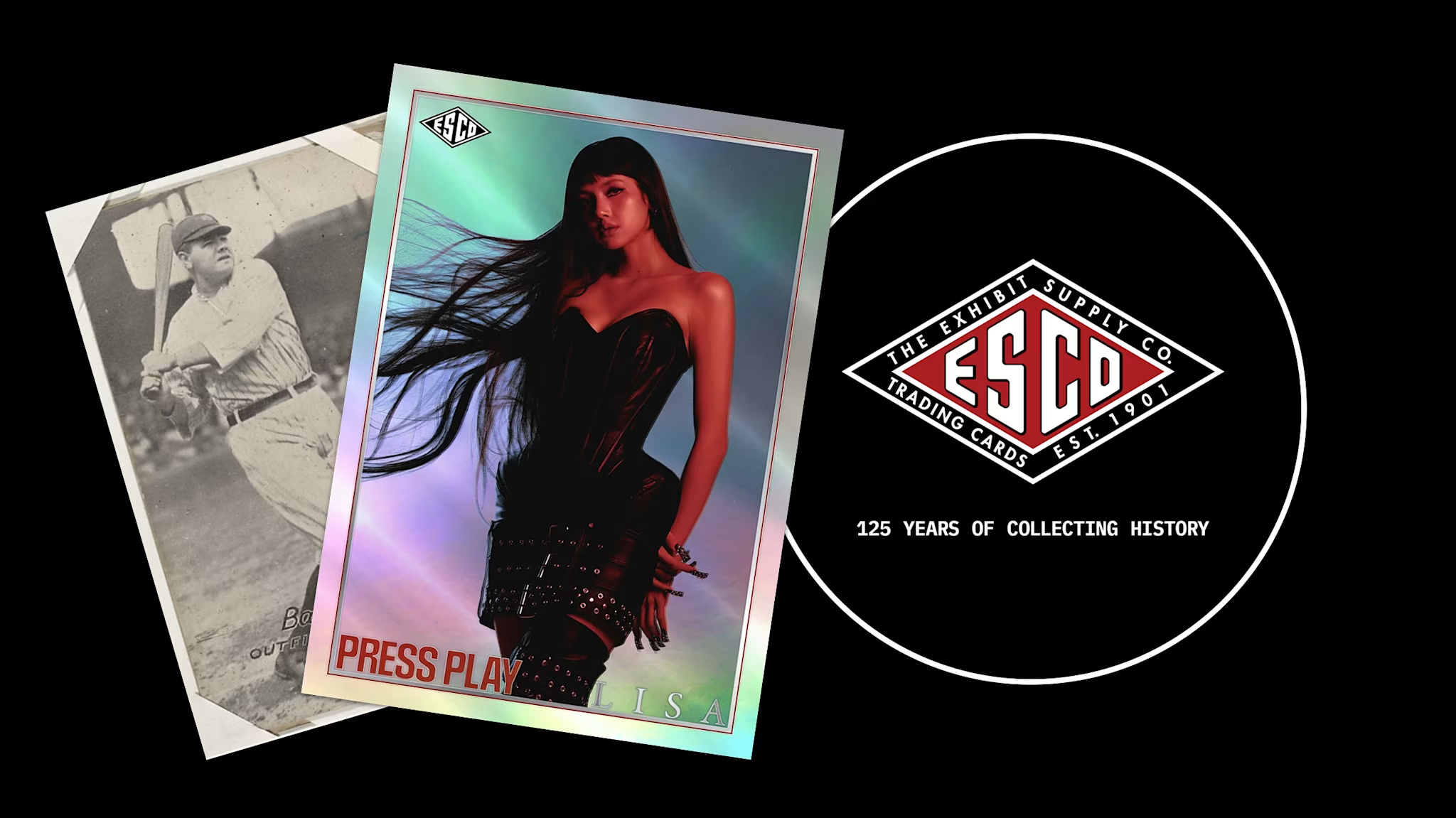
ESCO was founded in Chicago in 1901 and is credited with helping invent the modern trading card. For more than half a century it put the biggest stars in America on thick card stock, from silent film icons and baseball legends to The Beatles, and sold them one penny at a time out of arcade machines it built itself. Those cards are now some of the most studied pieces of vintage hobby history. In 2026, the brand came back with a very specific mission: to become the premium trading card brand for music and pop culture. So far, the brand’s return has resulted in exclusive trading card packs from global pop superstars LISA and KATSEYE. This is the full story of ESCO, from the cards and machines that made its name to why its return is landing at exactly the right time.
What Does ESCO Stand For?
ESCO stands for Exhibit Supply Company. The name comes from "exhibit cards," the postcard-sized picture cards the company printed and sold through coin-operated arcade machines in the early 1900s. Collectors still use the term today for arcade-era cards, even ones made by other companies.
Who Founded ESCO?
ESCO's story runs through J. Frank Meyer, a printer born in Peoria, Illinois, in 1881 who came to Chicago with a fifth-grade education. By the early 1900s his Meyer Printing Company was working out of the Pontiac Building on South Dearborn Street, in the heart of the city's Printers' Row. Exhibit Supply Company was then a small arcade partnership, established in 1901. Meyer joined it in 1907 and was running it by 1910.
Meyer saw that America's booming penny arcades needed a steady supply of things to sell, and he knew how to print them. His early machines stamped custom messages onto metal ribbons. Soon ESCO machines were vending postcards, horoscopes, and photos. After World War I the business took off, and ESCO quickly became one of the major manufacturers of arcade games in the country.
What Were ESCO Exhibit Cards?
The product that made ESCO famous was the exhibit card. Each one was roughly postcard-sized, about 3 3/8 by 5 3/8 inches, printed on thick card stock in a single tint: sepia, blue, pink, red, or green. Movie stars usually got a greeting and their name in script across the front. Backs were either blank or printed as postcards, so a card could be mailed home from the boardwalk. Most cost a penny. The racier "art model" pin-up cards could fetch a nickel and were the most profitable cards in the arcade.
The range was enormous: baseball players, boxers, wrestlers, movie stars, cowboys, radio and TV stars, cars, planes, jokes, love letters, and fortune cards. Most exhibit cards were never sports cards at all. Meyer kept arcade operators stocked by promising them, "We release a new series of cards every 30 days." Operators bought cards in paper-wrapped "bricks," and as late as 1949 a brick of 1,000 cost $3.85.
ESCO never numbered its cards or published checklists, which is why collectors are still piecing sets together a century later. That mystery is part of the appeal.
The Machines Behind the Cards
ESCO didn't just print the cards. It built the machines that sold them. By 1917 the company was manufacturing its own card vendors, and the machines were designed to take only cards of ESCO's exact size and thickness. A new machine arrived loaded with about 1,200 cards, dispensing two different series side by side. Every refill had to come from Chicago.
The model scaled fast. By 1921, ESCO reported roughly 5,000 of its card machines in operation nationwide, selling around 40 million cards a year. The catalog grew to include claw-style digger machines, strength testers, shooting games, and fortune tellers. Around 1924, Meyer moved operations into a large plant at 4222 West Lake Street, where ESCO would eventually employ as many as 285 people.
The machines were built to last, and so were the cards inside them. In recent years, two ESCO machines loaded around 1953 turned up still holding 428 near-mint cards of movie stars, ballplayers, boxers, and cowboys, untouched for more than six decades.
Babe Ruth, Lou Gehrig, and ESCO's Baseball Cards
ESCO printed its first baseball and boxing cards in 1921. Its 1921 Babe Ruth is one of the earliest cards of Ruth as a Yankee. According to Sports Collectors Digest, ESCO was the first company to make trading cards that weren't advertisements or freebies tucked into packs of tobacco, candy, or gum. You paid for the card itself, and that idea is the foundation of the modern hobby.
The 1925 set is the one collectors chase hardest. At 128 cards, it was ESCO's biggest yet, featuring Ruth, Ty Cobb, Walter Johnson, and Rogers Hornsby. It also includes Lou Gehrig's rookie card, the most valuable ESCO card ever made. Strong graded copies now sell for a couple hundred thousand dollars. Telling a true 1925 Gehrig from the nearly identical 1926 reissue comes down to the tint: light gray for 1925, faint blue for 1926.
ESCO kept reinventing the format. In 1929 it switched to four players on one card, and a 1935 four-on-one featuring Ruth with the Boston Braves is one of the last cards issued during his playing career. In 1939 it went back to one player per card, now with "salutations" and signatures written in by ESCO artists. That led into the long run collectors call the 1947 to 1966 Exhibits, home to Mickey Mantle, Stan Musial, and a Ted Williams card that used the same photo from 1946 to 1961, even after he retired.
ESCO issued baseball cards for so many years that Topps didn't break its record until 1996. Its run of current players ended in 1966, when Topps' exclusive player contracts forced ESCO to pull six players, including Hank Aaron and Don Drysdale, from cards that had already been printed.
The Beatles and ESCO's First Music Cards
ESCO found its next great subject in music. When Beatlemania hit the U.S. in 1964, ESCO was ready with black-and-white exhibit cards of John, Paul, George, and Ringo, followed by The Rolling Stones. In the same era, ESCO printed a set of recording artists with short biographies on the backs, an early version of the formula every music card still follows: the image on the front, the story on the back. Original 1964 Beatles exhibit cards still trade hands on the collector market today.
How the Penny Arcade Era Ended
World War II changed ESCO. The company shifted most of its plant to war production, building switches used to open bomb bay doors and parts for submarine radar. Its switch division eventually grew bigger than the arcade business. J. Frank Meyer died in 1948 at 67, and by 1960 ESCO had spun off the switch business and moved into much smaller quarters a few blocks down Lake Street. By 1965 it had 15 employees.
The arcades themselves were fading, but ESCO kept printing for loyal operators, switching to bright white card stock in 1968 and issuing Baseball Hall of Fame sets as late as 1974 and 1977. In 1979, its remaining machines, presses, and an archive of more than 7,000 original photos were sold to a card dealer, and the ESCO name went quiet for more than four decades. Its cards never fully disappeared. At San Francisco's Musée Mécanique, vintage arcade machines still dispense exhibit-style cards printed from ESCO's photos.
ESCO Timeline: 125 Years of Trading Cards
- 1901: Exhibit Supply Company is established in Chicago as a small arcade partnership.
- 1907: Printer J. Frank Meyer joins the company. By 1910 he is running it.
- 1914: ESCO card machines are vending "art model" photos from Meyer's Printers' Row office.
- 1917: ESCO is building its own card vending machines.
- 1921: ESCO issues its first baseball and boxing cards, including an early Babe Ruth as a Yankee. About 5,000 ESCO card machines are in operation, selling roughly 40 million cards a year.
- 1924: ESCO moves into its plant at 4222 West Lake Street.
- 1925: The 128-card baseball set debuts, including Lou Gehrig's rookie card.
- 1929: ESCO's Star Picture Stamps series puts Babe Ruth alongside Charlie Chaplin and other movie stars.
- 1939: Single-player baseball cards return, with "salutations" signed by ESCO artists.
- 1941 to 1945: ESCO shifts to war production.
- 1947 to 1966: The classic run of baseball exhibits, featuring Mickey Mantle, Stan Musial, and Ted Williams.
- 1948: J. Frank Meyer dies.
- 1964: ESCO prints Beatles exhibit cards as Beatlemania hits America.
- 1966: ESCO's run of current baseball players ends amid Topps' exclusive contracts.
- 1979: ESCO's machines, presses, and photo archive are sold, and the brand goes dormant.
- July 2026: ESCO returns as ESCO Trading Cards, focused on music and pop culture.
- August 2026: The ESCO x KATSEYE "WILD" set debuts on Complex and at Target stores nationwide.
- October 2026: The ESCO X LISA HANGERPACK debuts on Complex.
ESCO's 2026 Return
On July 29, 2026, ESCO officially came back as ESCO Trading Cards. The relaunch keeps the name and the history but narrows the focus to a single lane: premium music and pop culture collectibles. ESCO calls itself the only premium trading card brand dedicated exclusively to that space, and it is building the product to match.
ESCO is planning to launch premium boxed collections featuring some of the world's biggest artists, with authentic autographs and relic cards that hold pieces of stage-worn items. Distribution covers both sides of the hobby, from mass retail shelves to specialty hobby shops.
It is a full-circle move. The company that helped turn celebrities into collectibles a century ago is now betting that today's music fans want the same thing, just with serial numbers, parallels, and certified signatures.
ESCO x KATSEYE: The First Big Drop of 2026
ESCO's first major release of 2026 was the official ESCO x KATSEYE "WILD" Trading Cards, celebrating the global girl group's WILD EP and tour. The collection debuted on Complex in August, followed by Target stores nationwide, marking ESCO's first national retail rollout since its return. The now sold-out set features 50 all-new card designs, with each pack containing nine trading cards and one numbered foil card, plus the chance to find rare cards and hand-signed autographs from the members. With a global fanbase already immersed in photocard trading, rare pulls, and unboxing culture, KATSEYE was a natural fit to introduce a new generation of fans to ESCO's music collectibles.
ESCO x LISA: The 'PRESS PLAY' Collectible Set
ESCO followed KATSEYE with another major release: the 2026 ESCO x LISA Trading Card Pack, celebrating her new EP, PRESS PLAY. The collection features 50 card designs spanning PRESS PLAY, Alter Ego, and more, with each pack containing nine trading cards and one foil card, plus the chance to find rare foil cards and hand-signed LISA autographs. Building on the momentum of its KATSEYE launch, ESCO is expanding its retail reach with LISA packs available at Target, CardVault by Tom Brady, and select retailers across the UK and Asia.
What's Next for ESCO
KATSEYE and LISA announced the brand’s comeback, but that’s not the whole plan. ESCO has promised premium boxed sets from more of the world's biggest artists, with autographs and stage-worn relics, across both retail and hobby channels. If it delivers, the brand could do for music what Topps did for baseball: turn fandom into a collecting habit with its own rules, chases, and grails.
More than 125 years after J. Frank Meyer started printing picture cards for penny arcades, the idea behind ESCO hasn't really changed. People want to hold onto the stars they love. The only difference now is the artists on the front and the serial numbers on the back.