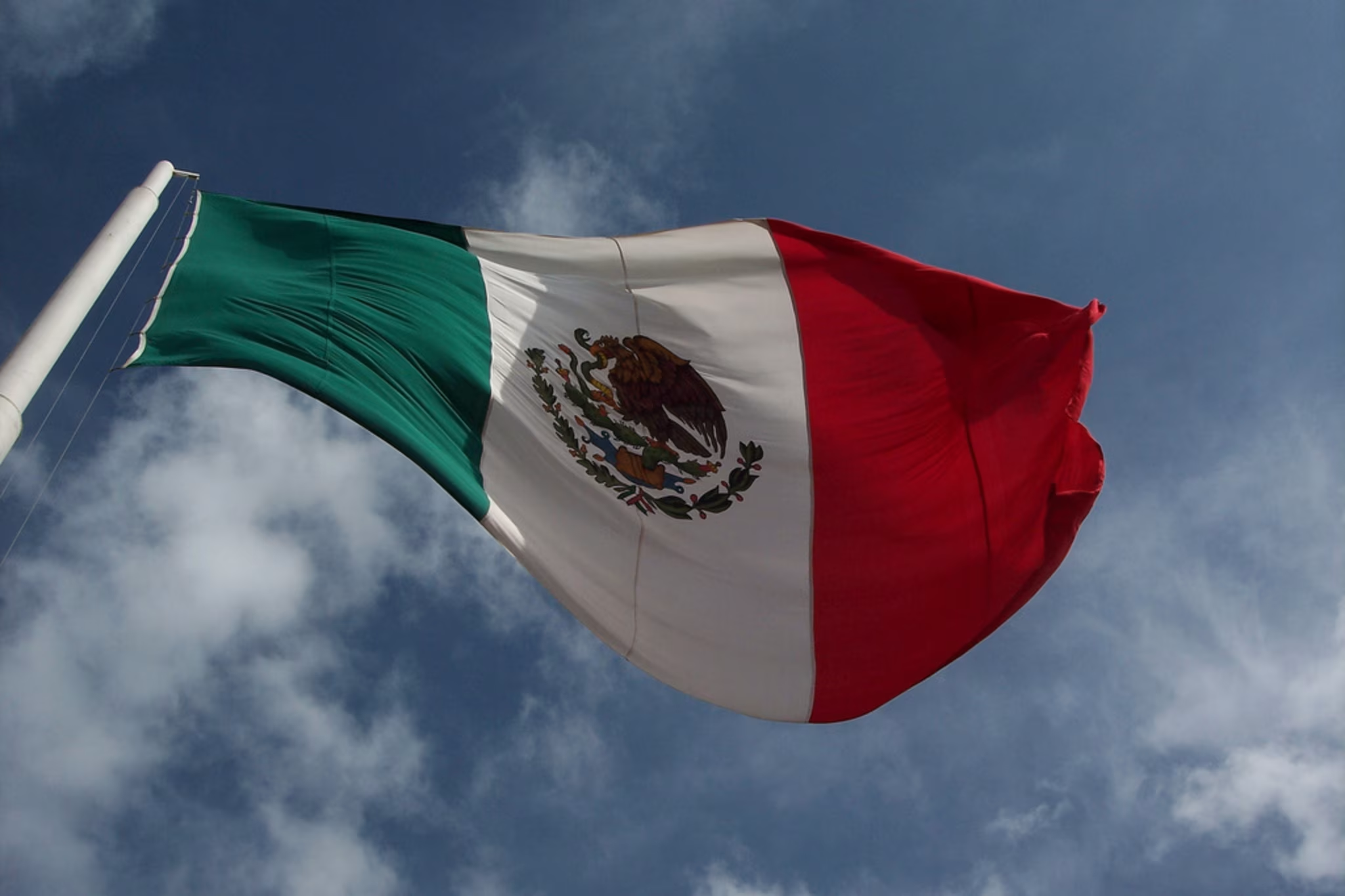
Image via Christian Frausto Bernal / Flickr
From Breaking Bad to the on-going El Chapo saga, to Narcos and multiple recent documentaries, the ultraviolent activities of the Mexican drug cartels have captured the public’s attention like no criminal operation in recent memory. Thanks to a combination of incomprehendible levels of violence, a perceived Pablo Escobar/ Tony Montana level of glamour, and maybe also the fact that a lot of us consume their products at the weekend, the cartels have become an extremely popular subject for modern day crime movies.
Sicario, starring Emily Blunt and Benicio del Toro, is the latest, and one of the best. It blends a tense thriller with a much wider examination of the Drug Enforcement Administration’s policing of the US/ Mexico boarder. Blunt plays a FBI agent spiralling way out of her depth, and slowly being manipulated by de Toro’s mysterious government advisor.
The film is out on DVD and Blu-ray now, and the PR team for the film put us in touch with former DEA agent Shelia Bond, to tell us what it’s really like out there battling the cartels on the ground. Bond has had quite a life, working not only in Mexico, but also in Seattle, LA, and even surviving an attempt on her life. Her most notable work however involved working on the case of Kiki Camarena—an undercover DEA agent who in 1985 was kidnapped and murdered by the cartels. After he helped the DEA destroy a massive marijuana plantation, Camarena was abducted by corrupt police working for notorious drug lord Miguel Ángel Félix Gallardo. He was tortured for 30 hours, with a doctor on hand to keep him alive so that more punishment could be inflicted. His death resulted in a massive US operation in Mexico to find his killers, which Bond was a part of.
You’ve had quite a career with the DEA—can you talk us through it?
I was a New York City police officer for three years, and I left that to go to the DEA. I travelled all over the place. I worked in Houston, where bikers were doing meth amphetamines. Then I went to LA and spent two years working on the Camarena investigation—our agent that was kidnapped in Mexico, who was tortured and killed. After that I stayed in LA as a gang expert, working Chinese gangs and black gangs. And then I worked in Seattle. I was even sent to Budapest to teach the former Soviet states that were now democratic, about search warrants and Miranda rights.
What is it actually like work undercover?
I worked undercover for state and local police, and DEA, in some very interesting cases. You know there’s always a chance you could be killed, and you have to be able to talk your way around stuff. If somebody asks you if you havea gun on you, and it’s just you against the three of them? You say “Fucking A, I’m carrying a gun.” You have to be able to say that. But psychologically, you get classes through the FBI, and you know how to talk to different people. The way you talk to an older Mexican is different to how you would with a young black kid.
So talk us through the Camarena case then.
Camarena’s problem, and I don’t think people like to admit it, was that he felt that these people were never gonna bother him because he’s Mexican. He felt that he would not be harmed. He was scheduled to have lunch with his wife the day {of his adduction}. He was egotistical. But he and his pilot had destroyed a marijuana field that was worth $2 million. So we’d hurt them in the wallet.
They had him hanging up, they tortured him in several different ways. They’d hold him upside down by his head, and shot cold soda into his face and up his nose. They pulled his hair out. They beat him. And when he passed out they had a doctor wake him up, so they could continue questioning him. And he lied about everything that they asked. They’d ask how many agents do you have in this country, and he would lie about that. And then they finally killed him, and nobody knew. The FBI did a good job, because they went to certain houses, and they found the licence plates for the car of the people that kidnapped him. So they could trace that, and the car where he was taken in.
So we found his body. They had him buried at one spot, then moved him to another. The FBI could tell that wasn’t the original spot because of the dirt that was on him. He was killed, and we didn’t know how. There was a hole in his head. It was not a bullet wound. We thought he might have been shot in the head, but there was no powder residue. What they used might have been a cattle prod, that they use to kill animals, with a bolt that goes into the brain, and then comes out. And that’s probably what they used.
We did several arrests in that case, one of which was actually the doctor’s wife—when she came into a hospital to be treated, we arrested her. I was the only one that spoke Spanish. She was getting into the trunk of the car, because that’s maybe how they transported suspects in Mexico. And I told her, no, get in the car. And then I heard that there was a $10 million bounty on my head, but that they would kill me fast, because I was nice to her.
How has it become so violent down there?
It used to be many years ago they would not kill a police officer. But imagine you make $1000 a year. And I’ll give you $500 if you kill that guy over there. It doesn’t matter if you take out the six people around him. So then it got to be ok to kill people. Prior to Camarena, there were these two kids from college who went into a bar, basically it was a drug bar. They were asking questions, they were journalistic kids or whatever. So they took them in the back and tortured them by stabbing them with ice picks, and killed them. Life means nothing. In the movie, when Benico Del Toro says “ Nothing personal”, he’s right, it’s not. It’s strictly business. Taking someone’s life means nothing.
Why do you think the Mexican drug cartels have captured the public’s attention so much?
For the same reason Camerena was killed. It’s all out of the wallet. It’s all about the money, because everyone has tons and tons of cocaine. And if this one particular cartel controls one part of California, and this other one has to go this area of Texas, it means the biggest problem is we have too many people in charge.
Getting arrested in Mexico is a piece of cake, because you’re treated like a king when you got to jail, because the corruption in the police, and in the army is tremendous. And if you have the guts to become President of something, or high up and in the government, and you’re legit, you’ll be assassinated. They’ve killed some high-ranking people.
Are the cartel heads like celebrities then?
They are treated like celebrities. Because they have a lot of money. They have a lot of people working for them. They upgrade their cars to have gold rims. Their children have everything. They have other people do their dirty work, you’ll never find them with drugs. If they are ever arrested, they’ll be put in their own prison cell, where they’ll have their own cook, they’ll be waited on like they’re in a hotel, for a little bit until they get let out. They’re big shots. They’re known as celebrities, and they’re talked about as celebrities.
Sicario is available on Blu-ray, DVD, and digital platforms now, from Lionsgate Home Entertainment.