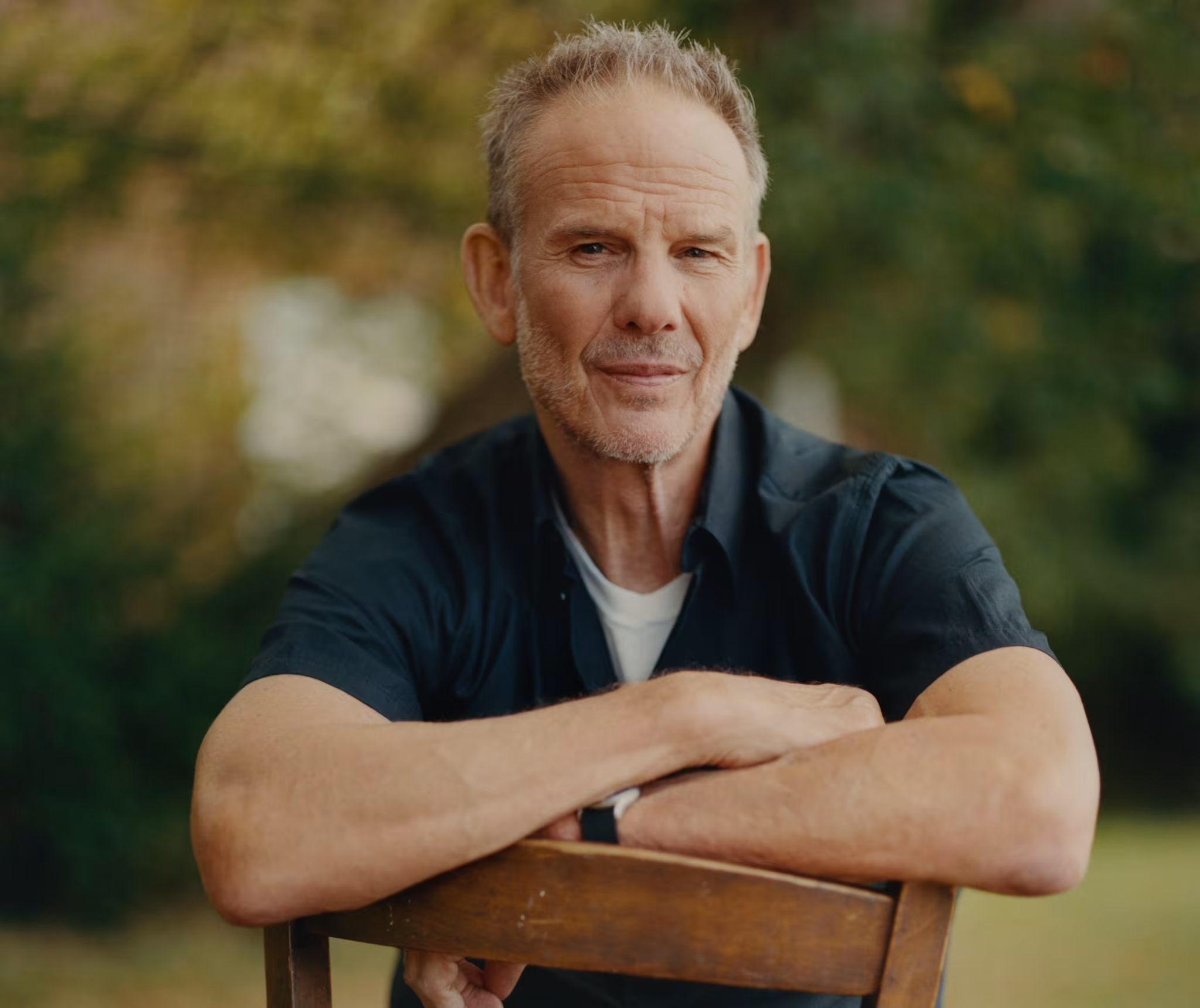
On a recent Saturday afternoon, the director Peter Berg was watching football on mute when he offered an explanation for the sport’s particular power in American life.
“Do you have a TV near you?” he asks. “Put on the UCLA-Michigan game.”
On the tube, players from both teams had formed a circle around injured UCLA quarterback Ty Dieffenbach. They knelt and held hands in prayer as Dieffenbach was carted off the field with what turned out to be a minor hip injury.


“I get emotional watching this. This is a scene right out of Friday Night Lights,” Berg says, referencing his film about high school football in West Texas.
“You’re asking me why football matters. It's the intensity of the game, the risk, the power,” Berg tells Complex. “It’s 11 against 11, where all 11 men have to perform in complete harmony in order to execute well. It’s this incredible pursuit of perfection with very real stakes, violent stakes, lurking. And the game itself is so mesmerizing that it pulls people in. Then you see communities organizing themselves—families, schools, and churches organizing around this incredibly complex, violent game. There's just nothing like it.”
At age 62, Berg’s lifelong passion for the sport is well documented. He played high school football at his boarding school in Connecticut and is a diehard New York Giants fan. Then there is Friday Night Lights. In 2004, he adapted his cousin Buzz Bissinger’s nonfiction bestseller about the 1988 Permian High School Panthers into a hit movie. A primetime series based on the film ran for five seasons and was equally beloved.
Berg turns his scope back to the gridiron this week with his latest film, The Mosquito Bowl.
Premiering on Netflix on November 25, the film tracks four college football stars who enlist in the Marines after Pearl Harbor and see battle in the Pacific Theater. Based on a true story, the titular game—a tackle football game between the 4th Marine Regiment and the 29th Marine Regiment—took place on Guadalcanal on December 24, 1944. Fifteen of the contest’s 65 participants were later killed during the Battle of Okinawa.
Berg also directed the show open for all four Netflix NFL games this season, the second of which debuts on Thanksgiving Eve prior to the Los Angeles Rams-Green Bay Packers tilt. Each spot features a montage of what Berg loves about football—the hard-hitting action coupled with the human connection—under a voiceover from Friday Night Lights star Kyle Chandler.
“I realized I’ve missed Friday Night Lights. I miss writing for Coach Taylor,” Berg says about how it all came together. “So I just thought it’d be interesting to write four different Coach Taylor locker room speeches—one for the season opener, one for Thanksgiving Eve, one for Christmas, and one for [Week 18]. They kind of just poured out of me.”
This is more than nostalgia. The humanism of the game that he captured in his series feels especially critical for Berg today.
“We’re doing this interview two days after Anthropic went public,” he says. “Technology is disrupting humanity intensely. Cell phones and apps have disrupted humanity very intensely. I think a sport like football remains incredibly popular because there is no AI on the field. There are human beings behaving like human beings—which is getting harder to do.”
“Life is just one gigantic crisis,” he says, quoting Bissinger from a recent Wall Street Journal essay. “I don’t think it’s ever been more true than today.”
Working with Rihanna, Mark Wahlberg, and The Rock
He grew up in Chappaqua, an affluent suburb about an hour north of New York City. A restless kid, Berg turned to athletics, taking up boxing in addition to football. But when he arrived at Macalester College in St. Paul, Minnesota, he found a home in the theater. Soon, he moved to Los Angeles where he became a working actor.
For the next decade, he hustled his way up from walk-on roles to co-starring in films such as the cult favorite Aspen Extreme, The Last Seduction, which earned him critical kudos, and Copland opposite Sylvester Stallone. Playing Dr. Billy Kronk across five seasons on the CBS drama Chicago Hope put him in demand, yet—cliche alert—what he really wanted to do was direct.
He wrote and directed Very Bad Things, a dark comedy about a Vegas bachelor party gone bad. A nasty piece of work, the film opened in November 1998 to meager box office ($3.2 million) and scathing reviews. It had its fans though, and soon Berg was meeting with Steven Spielberg and David Geffen about directing American Beauty for DreamWorks.
He’d blow that too, when, during the job audition, he suggested hiring his then-girlfriend Madonna for the female lead, a role that eventually earned Annette Bening an Oscar nomination.
“That was a rough one,” Berg says. “I’m a huge Madonna fan and think she would have been great in the movie. I stand by that. But, looking back, I probably should have waited until I had the job before suggesting it.”
Berg’s career took another hit in the spring of 2000 when ABC canceled the grim medical drama he created, Wonderland, after two episodes. How grim was it? The pilot episode included a mass shooting in Times Square and a skirmish in a mental hospital that ended with a patient stabbing a pregnant doctor in her uterus. The National Alliance for the Mentally Ill (NAMI) called the show “hazardous to public health.”
Depressed, and back in Los Angeles, one of the first calls he took was from the director Michael Mann (Heat, The Insider, Manhunter). When they eventually met for breakfast, they spoke for two hours about the show and what it all meant and how it was important for Berg to keep writing and creating.
“It was the first time anybody had acted like a mentor to me,” Berg says. “Micheal gave me incredible confidence and picked me up because [the cancellation] really hurt.”
He directed an action movie, The Rundown, with The Rock and then found his groove adapting Friday Night Lights for the big screen and then for weekly TV. Berg says the pilot episode is “probably my favorite thing I’ve ever done.”
From there, the directing jobs got bigger in both scope and budget: the underrated War on Terror thriller The Kingdom; Hancock, a Will Smith superhero movie that grossed $629 million worldwide; and the 2012 mega-bomb Battleship.
Some projects never materialized. He took a stab at Dune a decade before Denis Villeneuve but couldn’t deliver a script under 215 pages. “If we were smarter,” Berg says, “we would’ve sold it as a trilogy.” And he spent years filming a Rihanna documentary that will likely remain unreleased.
“There’s always hope. Keep hope alive,” Berg says, of the doc. “If and when it does [come out], it’s going to be a banger.”
Rihanna made her film debut as Petty Officer Cora “Weps” Raikes in Berg’s Battleship and hasn’t acted in a live-action film since Ocean’s 8 in 2018. Is he surprised she hasn’t made more movies?
“Rihanna does what she wants to do. She follows her heart. She follows her creative instincts,” Berg says. “When she did Battleship, she was really interested in seeing what being in a big, wild Hollywood action movie was like. And then she went and made a bunch of great albums and now she’s raising a beautiful family—I guarantee you she’s going to be back in music and it’s going to be a banger.”
Berg would find his niche with the 2013 hit Lone Survivor, a true story about Navy SEALS on a deadly reconnaissance mission in Afghanistan, which starred Mark Wahlberg. He became taken with the SEALs while researching the story and his work pivoted towards similar fare: tense, nonfiction stories about blue-collar men placed in extraordinary situations. Ideas of public service, heroism, brotherhood, patriotism, and humanity permeate his work.
This is what still interests him and where he feels the most engaged. The Mosquito Bowl fits well into that world.
Making war look like hell
The Mosquito Bowl is not a sports film. Berg prefers to call it a war movie that happens to have football players in it.
As in the book, which was also written by Buzz Bissinger, the game occupies a narrow slice of the film’s narrative. The Mosquito Bowl is a respite from the war, a brief moment when the soldiers of the 6th Marine Division can regain a piece of their innocence before facing the horrors of Okinawa.
While critics have long accused Berg’s films as doubling for military propaganda, he stresses that The Mosquito Bowl is an anti-war film. Before writing the screenplay, he toured the Pacific islands where hundreds of thousands of people lost their lives. Then he visited contemporary military bases and met the soldiers who’d be tasked with potentially defending Taiwan in the face of Chinese aggression. His perspective on the movie shifted.
“It was my hope to get people thinking about the cost of war,” Berg says. “[An estimated] 75 million people died during World War II. We [should] want to do everything we can to avoid that ever happening again.”
And so Berg decided early on not to sanitize the brutalities of combat. He watched graphic footage shot by Norm Hatch during the Battle of Tarawa and also took inspiration from Climax, Gaspar Noe’s 2018 horror film about a dance troupe whose retreat dissolves into a nightmare after their sangria is spiked with LSD.
“It’s not for everybody,” Berg says of the French cult favorite. “But it’s one of the most immersive experiences I’ve ever had in a film.
“I wanted to do something very visceral that took the audience as best as I could into the experience—the immersion of warfare as seen through the eyes of these young men. . . The combat becomes almost irrational, almost psychedelic in a horrific way. It becomes like a bad drug trip. . . I was definitely [aiming] for that, even if it was at the expense of character development.”
Berg succeeded in his mission, for the most part. The Mosquito Bowl features impressively brutal combat scenes. The landing at Tarawa, in particular, is harrowing—Marines flailing in the surf, hurtling onto the rocks, bullets whizzing past them as they emerge on the shore where the fighting continues. The sequence goes on and on with no escape hatch for the viewer—kind of like a bad drug trip.
But then there is a jarring cameo from ESPN’s Pat McAfee, who appears early on as a drill instructor on Parris Island. McAfee, who appeared in a 2025 Super Bowl commercial Berg directed, lobbied the filmmaker for the part. He then spent five days on Parris Island shadowing drill instructors before eventually reading for the role.
“He wanted it so bad,” Berg says. “He was right for the role. I really liked the guy. Let’s go for it. He memorized the Rifleman’s Creed and took it very, very seriously. I’m super proud of him.”
Berg hired him knowing the potential backlash. “Pat was aware that people were going to come at it with some attitude like, ‘Well, why is Pat McAfee acting?’ And he didn't care. He wanted to test himself. That's the kind of guy he is. He just pushes himself really hard in all aspects of his life. There's a reason he's as successful as he is. I love that kind of attitude. I love people that have that thirst and that curiosity for life.”
While McAfee is fine in the role, his presence is a distraction and one of the few moments where The Mosquito Bowl resembles a Hollywood production.
Up next, a Call of Duty adaptation.
Berg’s deep passion for the Marine Corps and his appreciation for the service comes from his father.
Larry Berg was a lieutenant in the Marine Corps, who never saw combat and spent most of the Korean War stationed on a ship off the coast of Korea. When he came home, he talked about his experience. By that point he worked in client relations for Gray Advertising. He handled the Jif peanut butter account; Berg’s mother Sally worked at a psychiatric hospital.
Later on in life, Berg and his father spent a lot of time together at the National WWII Museum in New Orleans and the National Museum of the Marine Corps near Washington D.C.. After Larry died in 2015, he was buried in Arlington National Cemetery.
When Berg first started working on The Mosquito Bowl, he would sometimes visit his father’s grave site and talk about Bissinger’s book and his plans for the movie.
He knows his father was one of the lucky ones. Other soldiers weren’t able to return home and live long, full lives. Earlier this year, Berg visited Seattle for the funeral of his friend, Andrew Honeyman, a former SEAL who committed suicide.
During down time, he can be found hiking in the mountains with his dog or playing chess. Lately, he’s also been playing a lot of Call of Duty—his next film will be an adaptation of the video game franchise, and he’s writing with Taylor Sheridan. But he can’t say much.
“Every time I talk about it I get in trouble,” Berg says, “so I’m not going to talk about it other than to say what’s already public, which is that we are exploring the Modern Warfare universe,” referencing one particular subgenre of the COD universe “So, for any Call of Duty fans, and there’s a lot of them, think about Modern Warfare.”
Some gamers may recall that in a 2013 interview Berg had criticism for the hobby. Recalling his mindset today, he says that he’d just come back from Iraq, where he was conducting research for Lone Survivor, to find his son and his friends playing video games five hours a day. “I had to put a regulator on how much video games are allowed to be played. And I was implying that maybe it's not a good idea to play video games six hours a day. And that's what I was saying. And I still don't know that it is a great idea to play video games six hours a day.”
“Listen, I was never dissing Call of Duty games,” he says.
Conducting research for the film has brought Berg head on with the world of defense contractors (“A personal obsession,” he says) and artificial intelligence.
Of the latter, he’s wary—and not just because of the damage it may do to the movie industry.
“It’s much broader than our business. Anthropic freely admits that there's a chance their product could destroy civilization. I mean, let's just start with that,” he says. “It's like it can create medical cures and it can help with air traffic control—in theory—but it can also destroy human life as we know it on this planet.”
He continues. “So I don't know that the film business is any more vulnerable than any other business. I feel like we're all vulnerable right now.”