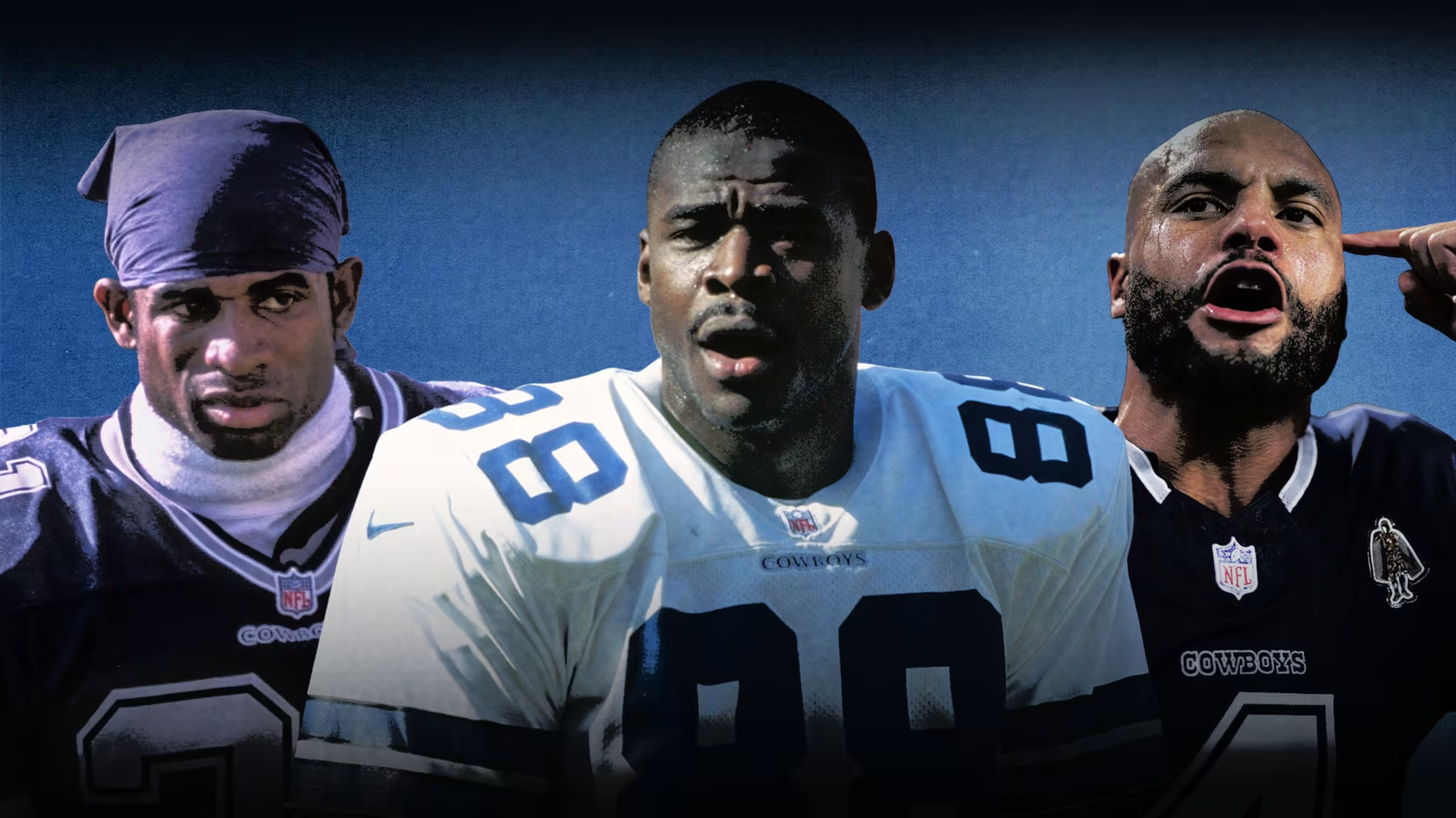
The Dallas Cowboys are America’s Team for good reason.
One of the premier glamour franchises in North American sports, the Cowboys are known for their celebrity and success, although they haven’t enjoyed much of the latter in recent decades. Dallas has made eight Super Bowl appearances and won five, which is second all time in both categories. Their current championship drought (30 years and counting) hasn’t hurt their bottom line though.
Despite not making an NFC Championship game since January 1996, the Cowboys generated $1.28 billion in revenue in 2024, the largest total ever recorded for a sports franchise, and the team is valued at anywhere between $15-17 billion and rising.
The Cowboys are Roger the Dodger. Bullet Bob. Dandy Don. Dak and Dez. Romo and TO. Deion. The Doomsday Defense, the Great Wall of Dallas, and the Triplets—Troy, Emmitt, and The Playmaker. Thirty two former Cowboys are enshrined in the Pro Football Hall of Fame despite the team being one of the younger NFL franchises, having been established and founded in 1960.
The star power extends to the sidelines, where Tom Landry and Jimmy Johnson once stood and where the Dallas Cowboys cheerleaders perform. It goes all the way up to the owners suite where Jerry Jones (great marketer, mediocre general manager) has resided for almost four decades. And then there are the stands at AT&T Stadium (a.k.a. Jerry’s World) where celebrity fans such as Denzel, LeBron, and Dubya cheer on America’s Team. The Cowboys are so famous that they are as synonymous with Thanksgiving as turkey and pumpkin pie!
The Dallas Cowboys are the engine behind the moneymaking entity known as the National Football League. But who are the best players to ever wear the star on their helmet?
These are the 30 Best Dallas Cowboys of All Time, Ranked.
Terrell Owens
Seasons: 2006–2008
Super Bowl Appearances: None
Super Bowl Wins: None
Accolades: 1x Pro Bowl, 1x First Team All Pro
Owens’ time in Big D was short but impactful. In three seasons with the Cowboys, TO averaged 78 catches and a shade under 1200 yards receiving per season, along with 38 total touchdown catches. He was an early security blanket for Tony Romo and helped the team make the playoffs in 2006 and 2007. Though he displayed grit playing through injuries and put up big numbers, Owens stint in Dallas is best remembered for an interview. Following the Cowboys’ loss to the New York Giants in the NFC Divisional Round, Owens broke down in tears defending Romo from criticism.—Thomas Golianopoulos
Ezekiel Elliott
Seasons: 2016-22, 2024
Super Bowl Appearances: 0
Super Bowl Wins: 0
Accolades: 2016 First-Team All-Pro, 2018 Second-Team All-Pro, 3x Pro Bowl, 2x NFL rushing yards leader
“Zeke” was arguably the best running back in the NFL in the mid-late 2010s. Elliott made an immediate impact as a rookie in 2016-17, leading the NFL in rushing yards with 1,631. That total was the third-most rushing yards by a rookie in NFL history (only Eric Dickerson and George Rogers had better rookie campaigns). The 2016 NFL Draft was a phenomenal one for the Cowboys as they secured an elite RB in Elliott and their QB of the future as well, in Dak Prescott. Prescott and Elliott, who quickly became best of friends, finished 1-2 for 2016-17 NFL Rookie of the Year honors. Zeke had six straight seasons with 900 rushing yards or more from 2016 to 2021. In four of those campaigns he went over the 1,000-yard mark. —Matt Burke
Dez Bryant
Seasons: 2010-2017
Super Bowl Appearances: None
Super Bowl Wins: None
Accolades: 3x Pro Bowl, 1x First Team All Pro, 2014 TD Reception Leader
Despite appearing in just three games during his junior season at Oklahoma State, Dez Bryant was the best receiver in the 2010 NFL Draft, yet NFL teams were concerned about “character issues” and he fell until the Cowboys traded up for him at 24 overall. Bryant would go on to be one of the most productive wide receivers of the early 2010s. A big, physical target on the outer edge, Bryant was known to bully smaller corners and was adept at using his strength and positioning to snare contested balls—the Romo-to-Dez back shoulder fade was unstoppable at times. And yes, Dez caught it.—TG
Bob Hayes
Seasons: 1965-74
Super Bowl Appearances: 2
Super Bowl Wins: 1
Accolades: 2x First-Team All-Pro, 1x Second-Team All-Pro, 3x Pro Bowl, 1965 and 1966 NFL receiving touchdowns leader
Some sports nicknames are hyperbole, but Bob Hayes earned the moniker of “Bullet.” Hayes won an Olympic gold medal in the 100-meter dash, as well as another gold medal in the 4x100-meter relay at the 1964 Summer Olympics. He is the only man to have won both a gold medal at the Olympics, and a Super Bowl ring. The lightning-fast wide receiver routinely confused NFL defenses with his unprecedented speed. “[Hayes] had several speeds. All of them fast,” said St. Louis Cardinals Hall of Fame safety Larry Wilson. “But defensive backs had to figure out which [speed] he was using and which one he was going to use.” His top season with the Cowboys came in 1966 when he had career highs of 64 receptions, 1,232 yards and 13 touchdowns.—MB
Micah Parsons
Seasons: 2021-24
Super Bowl Appearances: 0
Super Bowl Wins: 0
Accolades: 2021 NFL Defensive Rookie of the Year, 2x First-Team All-Pro, 2023 Second-Team All-Pro, 4x Pro Bowl
Parsons’ time in Big D was brief, and things ended messy between him and Jerry Jones, but there’s no denying that Parsons was an absolute beast from the moment he entered the league. After stealing Parsons in the NFL Draft at No. 12 overall in 2021, Parsons recorded a franchise rookie record for sacks with 13. He also tied for the NFL lead in tackles for loss that season with 20 on his way to winning NFL Defensive Rookie of the Year. The former Penn State standout recorded at least 12 sacks in all four seasons that he played with the Cowboys.—MB
Don Meredith
Seasons: 1960–1968
Super Bowl Appearances: None
Super Bowl Wins: None
Accolades: 3x Pro Bowl
Dandy Don was the first true superstar for the team with the star on its helmet. One of the most popular players in Cowboys history, Meredith was born in Mount Vernon, Texas, about 100 miles east of Dallas. Cowboys fans loved his toughness, big personality and bigger arm. Meredith took chances in the pocket for which he was often rewarded and led the Cowboys to back-to-back NFL Championship Game appearances, where they lost to the Green Bay Packers. Meredith retired early at 30 years old and went on to be an original member of the Monday Night Football booth.—TG
Charles Haley
Seasons: 1992-96
Super Bowl Appearances: 3
Super Bowl Wins: 3
Accolades: 1x First Team All-Pro, 2x Pro Bowl
The Cowboys’ trade for Charles Haley in August of 1992 proved to be one of the more pivotal transactions in franchise history. Haley had won two championships with the 49ers and proved to be the missing piece in Dallas’ quest to get back to Super Bowl glory. Haley was a relentless edge rusher with an explosive first step who recorded double digit sacks for the Cowboys in 1994 and 1995. But he was versatile and could also stop the run or drop back in zone coverage. Haley was the all time leader with Super Bowl rings until Tom Brady won his sixth.—MB
Darren Woodson
Seasons: 1992-2003
Super Bowl Appearances: 3
Super Bowl Wins: 3
Accolades: 3x First-Team All-Pro, 5x Pro Bowl
Woodson is a true Cowboys great, having played his entire 12-season career in Dallas. He finished his career as the franchise’s all-time leading tackler at 1,350. The Arizona State product made 26 interceptions in his NFL career, and ran two of those back for touchdowns. Woodson was an extremely versatile defensive back, lining up at both safety spots. He was tremendous at stuffing the run, and also thrived while defending deep passes from opposing teams. The Cowboys acquired Woodson as a part of the famed Herschel Walker trade. Woodson was drafted No. 37 overall in the 1992 NFL Draft.—MB
CeeDee Lamb
Cowboys Seasons: 2020-present
Super Bowl Appearances: None
Super Bowl Wins: None
Accolades: 5x Pro Bowl; 1x First Team All Pro; 2x Second Team All Pro
The current holder of the Cowboys’ most iconic wide receiver number, No. 88, Lamb has joined a proud lineage that includes Hall of Famers Drew Pearson and Michael Irvin, as well as recent All Pro Dez Bryant. In just his seventh season, Lamb owns the Cowboys single-season records for receptions and yards in a season (collecting 135 and 1,749 in 2023), ranks first in yards per game among players with 20 games or more with the team, and is already fifth on the team’s all-time receiving yardage leaderboard (likely to be third after this season).—Jack Erwin
Harvey Martin
Seasons: 1973–1983
Super Bowl Appearances: 3
Super Bowl Wins: 1
Accolades: 4x Pro Bowl, 1x First Team All Pro, 3x Second Team All Pro, 1977 Defensive Player of the Year
Martin was one of the most fearsome pass rushers of his era. Though the NFL didn’t officially began recording individual sacks as an official statistic until 1982, we know that Martin registered at least 114 unofficial career sacks and that he led the team in sacks in seven seasons. The Dallas native is the only Cowboy to win Defensive Player of the Year and was co-MVP of Super Bowl XII along with Randy White.—TG
Dak Prescott
Seasons: 2016-present
Super Bowl Appearances: None
Super Bowl Wins: None
Accolades: 2016 Offensive Rookie of the Year; 4x Pro Bowl; 1x All Pro; 2023 Passing TD Leader
Like his predecessor Tony Romo, Prescott would be in the discussion for best quarterback in franchise history for a lot of teams. Teams, that is, that don’t count Roger Staubach and Troy Aikman on their all-time rosters. Now in his 11th season, Prescott has put together a very good career, albeit one with a Texas-sized hole in its resume.
Since being taken 135th overall in the 2016 draft, Prescott’s won Offensive Rookie of the Year and been selected to four Pro Bowls (over a nine-year span) and a second-team All-Pro team. He holds the Cowboys all-time record for passing yards, and ranks seventh in NFL history in completion percentage. Again, two thirds of the teams in the league would take a decade of QB production like Prescott’s. But he plays in Dallas and has never led his team past the Divisional Round of the playoffs. Add a Super Bowl appearance to the resume and he becomes great; add a Lombardi Trophy and he’s a Hall of Famer.—JE
Tony Romo
Seasons: 2004–2016
Super Bowl Appearances: None
Super Bowl Wins: None
Accolades: 4x Pro Bowl
An undrafted free agent out of Eastern Illinois, Romo would go on to spend a decade in the most pressure-packed position in sports: starting quarterback for the Dallas Cowboys. Romo’s athleticism and moxie made believers out of then-Cowboys assistant Sean Peyton and Cowboys head coach Bill Parcells following an invite to Cowboys camp. Eventually, he took over for an aging and ineffective Drew Bledsoe during the 2006 season. Romo revived the Cowboys offense and led the team to the postseason where they’d lose a heartbreaker to the Seattle Seahawks after Romo fumbled the snap on a game-tying extra point.
The loss was a microcosm of the Romo era: spectacular play mixed with the occasional unforced error often that resulted in postseason failure. (Romo had a career 2-4 record in the playoffs.) Though Dak Prescott has surpassed him in the Cowboys record book, Romo has the edge over his replacement due to his superior play in the clutch; Romo had the highest fourth quarter quarterback rating in the NFL from 2006 to 2013.—TG
Tyron Smith
Seasons: 2011–2023
Super Bowl Appearances: None
Super Bowl Wins: None
Accolades: 8x Pro Bowl, 2x First Team All Pro, 3x Second Team All Pro
Tyron Smith spent over a decade protecting the blind of side of Dallas’ quarterbacks Tony Romo and Dak Prescott and was rewarded for it with, at the time, the largest contract ever given to an offensive lineman. What made him so special? Smith possessed a freakish combination of size (6 foot 5, 320 lbs. with huge mitts), speed (4.9 40-time), strength (Smith was said to benchpress between 600 and 700 lbs.), and skill and he used these attributes to become one of the best left tackles of the 2010s. —TG
Cliff Harris
Cowboys Seasons: 1970-1979
Super Bowl Appearances: 5
Super Bowl Wins: 2
Accolades: 6x Pro Bowl; 4x First Team All Pro; 1x Second Team All Pro
One of five players to play in all five of the Cowboys’ 1970s Super Bowl appearances, Harris was an undersized free safety nicknamed “Captain Crash” (an all-time great nickname) for his all-out style of play. Undrafted out of college, Harris eventually teamed up with Charlie Waters to form the preeminent safety duo in the NFL in the ‘70s. With Harris patrolling the secondary, Dallas finished in the top 10 in yards allowed each year of the decade.—JE
Drew Pearson
Seasons: 1973-83
Super Bowl Appearances: 3
Super Bowl Wins: 1
Accolades: 3x First-Team All-Pro, 3x Pro Bowl, 1977 NFL receiving yards leader
Incredibly, Pearson came to the Cowboys as an undrafted rookie out of the University of Tulsa. At the time of his retirement in 1984, Pearson was the Cowboys’ all-time leader in receptions (489) and receiving yards (7,822). Nicknamed “Mr. Clutch”, Pearson was on the receiving end of three of the most memorable plays in Cowboys history. He caught a game-sealing 83-yard touchdown in a 1973 playoff game against the LA Rams. On Thanksgiving Day in 1974, Pearson caught the game-winning TD from backup QB Clint Longley in a 24-23 Dallas win over Washington. Most notably was Pearson’s 50-yard Hail Mary catch from Roger Staubach with 24 seconds left in a 17-14 playoff win over the Minnesota Vikings.—MB
Chuck Howley
Seasons: 1961–1973
Super Bowl Appearances: 2
Super Bowl Wins: 1
Accolades: 6x Pro Bowl, 5x First Team All Pro
An outside linebacker from West Virginia, Howley was a founding member of Dallas’ famed Doomsday Defense. He was excellent against the run and the pass, notching 25 interceptions and 18 fumble recoveries during his 13-year career with the Cowboys. Howley saved his best for big games too. He was named MVP of Super Bowl V after snagging two interceptions and recovering a fumble in the Cowboys’ 16-13 loss to the Baltimore Colts, making him the only player from a losing team to win the honors. Howley then had 10 tackles, and interception, and a fumble recovery in Dallas’ 24-3 win over the Dolphins.—TG
Rayfield Wright
Cowboys Seasons: 1967-1979
Super Bowl Appearances: 5
Super Bowl Wins: 2
Accolades: 6x Pro Bowl; 3x First Team All Pro; 3x Second Team All Pro
Another member of the select group to appear in all of the Cowboys’ ‘70s Super Bowls, Wright was the right tackle who provided the foundation for the team’s offensive dominance in that decade. Originally drafted as a tight end, Wright moved to tackle in his third season. From 1970 through 1976, “The Big Cat” started 94 of a possible 98 games for Dallas, bringing a tight end’s athleticism to the blocking and pass protecting duties of a tackle, paving the way for Roger Staubach’s success and the team’s first five 1000-yard rushers.—JE
Deion Sanders
Seasons: 1995–1999
Super Bowl Appearances: 1
Super Bowl Wins: 1
Accolades: 4x Pro Bowl, 3x First Team All Pro, 1x Second Team All Pro
After you beat ‘em, join ‘em. Deion Sanders helped the San Francisco 49ers end the Cowboys’ attempt to threepeat but his San Fran sojourn would last one season. In September 1995, the Cowboys made Prime Time the highest paid defensive player in NFL history. He was still near the peak of his powers with the Cowboys, locking up the opposition’s top wide receiver and striking fear into the hearts of special teams coordinators as a punt returner. With Sanders shoring up the defense, the Cowboys would go on to win Super Bowl XXX. Sanders also returned two interceptions for touchdowns, four punt returns for touchdown, and caught a TD pass during his five seasons in Dallas.—TG
DeMarcus Ware
DeMarcus Ware
Cowboys Seasons: 2005-2013
Super Bowl Appearances: None
Super Bowl Wins: None
Accolades: 7x Pro Bowl; 4x First Team All Pro; 3x Second Team All Pro; 2008, 2010 Sacks Leader
DeMarcus Ware led the defense in a Cowboys era that could’ve—probably should’ve—produced more hardware than it did. Between his debut in 2005 and departure for the Broncos (and a Super Bowl ring) in 2014, Ware set the franchise record for sacks with 117 and also forced a Cowboys career best 32 fumbles. Despite Ware’s dominance, Dallas’ defense mostly disappointed during his Cowboys career, often due to a leaky secondary. Ware led the league in sacks in ‘08 and ‘10, but Dallas was unable to make the playoffs either year. D-Ware was ultimately elected to the Hall of Fame in 2023, his second year of eligibility.—JE
Tony Dorsett
Cowboys Seasons: 1977-1987
Super Bowl Appearances: 2
Super Bowl Wins: 1
Accolades: 1977 Offensive Rookie of the Year; 4x Pro Bowl; 1x First Team All Pro; 2x Second Team All Pro
The marquee player for the Cowboys’ “America’s Team” era of the late ‘70s/early ‘80s, Dorsett broke into the NFL in 1977, won Offensive Rookie of the Year, and promptly led the team to its second Super Bowl title. Dorsett was coming off a national title with his hometown Pittsburgh Panthers, and was initially considered too small for an NFL running back. The Cowboys selected him with the second overall pick, and he led the team in rushing for his first ten seasons. He also revolutionized the position, introducing an effortless gliding style personified by his record-setting 99-year run in the final game of the 1982 season (on a play where his team only used 10 players). The Cowboys lost the Super Bowl in Dorsett’s second season and made the NFC Championship three more times, but were never able to win another chip in his career.—JE
Jason Witten
Cowboys Seasons: 2003-2017, 2019
Super Bowl Appearances: None
Super Bowl Wins: None
Accolades: 11x Pro Bowl; 2x First Team All Pro; 2x Second Team All Pro
A lot of things changed between 2003 and 2017: MySpace got beat by a savvier but lamer competitor; the US elected its first Black president and its first orange one; Kanye West went from superproducer with a rhymebook to The Life of Pablo. One thing that didn't change during that span? The TE1 for the Dallas Cowboys.
Jason Witten started in his NFL debut on September 7, 2003 (five weeks after MySpace was launched), and went on to start another six games during his rookie season. With the exception of single games in the ‘04 and ‘06 seasons, Witten would be the starting tight end for the Cowboys for the next 14 years. He finished his career with the third most receiving yards by a tight end in league history (behind Tony Gonzalez and Travis Kelce), and made four All Pro and 11 Pro Bowl teams. Passed over on his first try at the Hall of Fame in a loaded class last year, he seems certain to make it to Canton in 2027.—JE
Mel Renfro
Seasons: 1964-77
Super Bowl Appearances: 4
Super Bowl Wins: 2
Accolades: 4x Second-Team All-Pro, 10x Pro Bowl, 1969 NFL interceptions leader, 1964 NFL kickoff return yards leader
When the Cowboys would sometimes use cornerback Deion Sanders on offense in the 1990s, it harkened back to another DB who Dallas used the on both sides of the ball. The ultra-athletic Renfro briefly started at halfback for the Cowboys before returning to the secondary, where he made his bones. The former Oregon track-and-field star had a key interception in the 1970 NFC Championship Game against the 49ers, which led to a Dallas victory and a berth in Super Bowl V. He had 52 interceptions in his Cowboys career, which is a franchise record. In addition, Renfro was a key special teams performer in his Dallas career, as he returned 85 kickoffs for 2,246 yards and 2 TDs, and 109 punts for 842 yards and 1 TD.—MB
Zack Martin
Seasons: 2014–2024
Super Bowl Appearances: None
Super Bowl Wins: None
Accolades: 9x Pro Bowl, 7x First Team All Pro, 2x Second Team All Pro
Prior to the 2014 NFL Draft, the Dallas Cowboys were linked to Texas A&M quarterback Johnny Manziel at the 16th pick. It seemed like a no-brainer. Here was a Texas kid, Heisman winner, the biggest celebrity in college football destined to play QB for the America’s Team. Instead, Cowboys owner Jerry Jones made perhaps his wisest decision. He passed on Manziel, who’d flame out of the NFL after two seasons, and drafted offensive lineman Zack Martin. The Notre Dame alum would go on to anchor the offensive line for a decade and become one of the most decorated interior linemen in NFL history.—TG
Michael Irvin
Seasons: 1988-1999
Super Bowl Appearances: 3
Super Bowl Wins: 3
Accolades: 1991 First-Team All-Pro, 1992 and 1993 Second-Team All-Pro, 5x Pro Bowl, 1991 NFL Receiving Yards Leader
“The Playmaker” was as brash as they come. The big, physical receiver would talk trash to every cornerback that stood in his way after removing his oversized, pacifier-style mouthguard. Irvin played tremendously well in big games. The former star WR of “The U,” Irvin had 114 yards receiving and 2 TDs against the Bills in Super Bowl XXVII. In the 1994 NFC Championship Game, Irvin put up massive numbers in a losing effort. Despite Deion Sanders being draped all over him for most of the game, Irvin still recorded 12 catches for 192 yards and 2 TDs.—MB
Larry Allen
Larry Allen
Cowboys Seasons: 1994-2005
Super Bowl Appearances: 1
Super Bowl Wins: 1
Accolades: 10x Pro Bowl; 6x First Team All Pro; 2x Second Team All Pro
Ever wonder how, despite the perils to brain and body seemingly inherent in an NFL career, Troy Aikman could have a highly successful post-playing stint as a TV analyst and Emmitt Smith could appear on “Dancing With the Stars”? The answer might be Larry Allen.
In a career that spanned the second half of the Troy Aikman era and the first years of Tony Romo’s career, Allen was a mainstay on the Cowboys’ offensive line. The accolades are staggering—Allen was selected to the Pro Bowl every year he played with the Cowboys except an injury-plagued 2002 season; he made six consecutive first team All-Pro teams between 1996-2001—but it’s how he did it that put him in a class of his own. He played across the offensive line, one of only three players in league history to make a Pro Bowl at two different OL positions. He once bench pressed 700 pounds. And, as a rookie, he chased down Darion Conner to prevent a pick six in a game against the Saints, despite weighing 75 pounds more than the New Orleans’ linebacker. There are a lot of great Cowboys, but only Allen is in the conversation for greatest of all time at his position.—JE
Randy White
Seasons: 1975-88
Super Bowl Appearances: 3
Super Bowl Wins: 1
Accolades: Super Bowl XII co-MVP, 8x First-Team All-Pro, 9x Pro Bowl,
“The Manster” was the Cowboys’ intimidator for 14 seasons. He even frightened his own teammates. “I wasn’t afraid of anything,” former Cowboys safety Charlie Waters said, “and Randy White scared me.” White was thought of as something of a bust early in his pro career after being picked second overall in the 1975 NFL Draft, as he struggled at middle linebacker. He was moved to defensive tackle in his third season, however, and the rest is history. He is now regarded as one of the finest defensive players in NFL history. White peaked in the 1978 season when he recorded a whopping 16 sacks.—MB
Troy Aikman
Seasons: 1989-2000
Super Bowl Appearances: 3
Super Bowl Wins: 3
Accolades: Super Bowl XXVII MVP, 6x Pro Bowl, 1993 Completion Percentage Leader
Aikman played his entire NFL career with the Cowboys and was Dallas’ steady leader under center during their 90s dynasty. The first overall pick of the 1989 NFL Draft was a driving force in the revival of the Cowboys under new owner Jerry Jones and new head coach Jimmy Johnson. Aikman saved some of his best performances for the playoffs with outstanding efforts in the 1992 NFC Championship Game against the 49ers (322 passing yards, 2 TDs with a 120.0 passer rating), the 1994 NFC Divisional Playoff against the Packers (337 passing yards, 2 TDs), and Super Bowl XXVII against the Bills (273 passing yards, 4 TDs with a 140.7 passer rating).—MB
Bob Lilly
Cowboys Seasons: 1961-1974
Super Bowl Appearances: 2
Super Bowl Wins: 1
Accolades: 11x Pro Bowl; 7x First Team All Pro; 2x Second Team All Pro
The anchor of the Cowboys’ 1960s “Doomsday Defense,” Lilly was an agile and fast defensive tackle who became “Mr. Cowboy” when Dallas began its run of excellence in the middle of the decade. From 1966 to 1973 the Cowboys finished first in their division every year but one, reached the conference finals six times, and appeared in two Super Bowls, winning one. His sack for a 29-yard loss in Super Bowl VI is still one of the most iconic defensive plays in SB history. One of the most beloved Cowboys to ever play, he was the first player to enter the team’s Ring of Honor, in 1975, and was ranked the 10th best football player (any team) of all time by The Sporting News as recently as 1999. He also holds one record that’s unlikely to ever be broken: He started every regular season game of his 14-year career. The only game he ever missed was the 1973 NFC Championship.—JE
Roger Staubach
Seasons: 1969-1979
Super Bowl Appearances: 5
Super Bowl Wins: 2
Accolades: Super Bowl VI MVP, 6x Pro Bowl, 1971 Second Team All-Pro, 1971, 1973, 1978, 1979 NFL passer rating leader, 1973 NFL passing touchdowns leader
“Captain America.” “Roger the Dodger.” “Captain Comeback.” All of those nicknames fit Staubach, who was the unquestioned on-field leader of “America’s Team” during their initial glory years of the 1970s. Staubach’s finest work came late in close games, when Dallas needed him to pull a rabbit out of his hat. “Roger had this statement that he likes to be surrounded by tea bags, because they perform best when the water’s the hottest,” said Staubach’s former Navy teammate Skip Orr on Staubach’s “A Football Life” episode. Staubach finished his NFL career with an 83.4 passer rating, which was the best mark by an NFL quarterback at that time. He also thrived as a runner, as he had 2,264 career rushing yards with 20 touchdowns.—MB
Emmitt Smith
Emmitt Smith
Cowboys Seasons: 1990-2002
Super Bowl Appearances: 3
Super Bowl Wins: 3
Accolades: 1990 Offensive Rookie of the Year; 1993 MVP; 8x Pro Bowl; 4x First-Team All Pro; 4x Rushing Leader
Despite winning an MVP and holding the all-time NFL records for rushing yards and touchdowns, Emmitt Smith was not the best running back in the league during his 15-year career. That’s what happens when you play at the same time as Barry Sanders. What Smith was though, was an all-time winner on one of the most storied franchises in sports, and by that metric, he might just be the greatest running back of all time.
Smith was a first ballot Hall of Famer in 2010; his four-season run between 1992-95 alone was probably enough to ensure his enshrinement in Canton. Over those four years Smith led the league in rushing yards and touchdowns three times each. In 1993, became the only player to win the rushing crown, regular season MVP, and Super Bowl MVP in the same season. Not coincidentally, Smith’s best seasons were the best four-year run in Cowboys history as well, with Super Bowl championships in ‘92, ‘93, and ‘95. Those squads were loaded, and Smith had a lot of help, but ultimately he was the best player on the best teams in franchise history—and the best Dallas Cowboy of all time.—JE