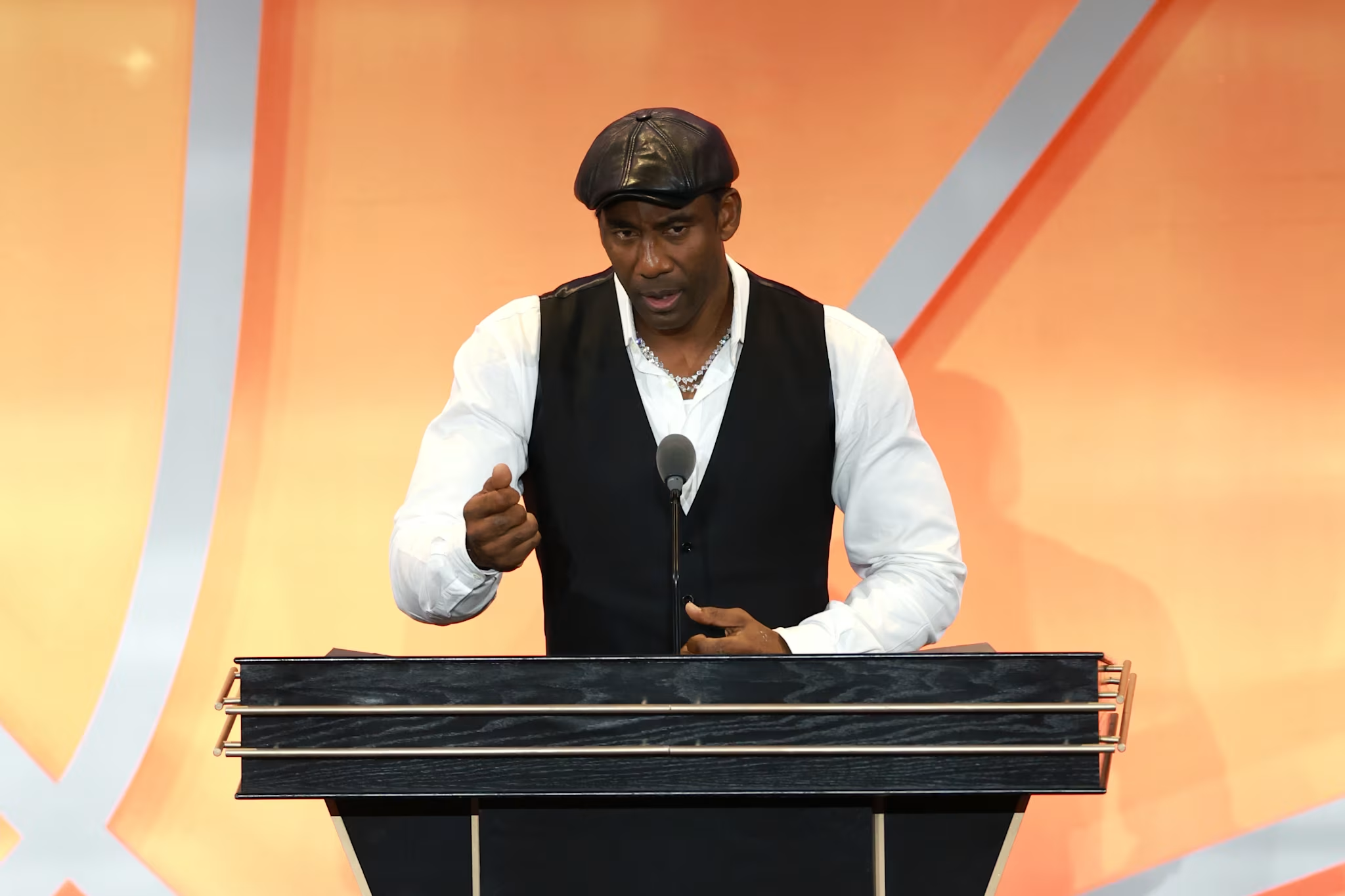
Retired NBA star Amar’e Stoudemire keeps adding to his resume. Earlier this year, he was inducted into the Basketball Hall of Fame and he has since started two wildly divergent new gigs.
First, Stoudemire is the latest former NBA player with a podcast. His show Amongst Legends debuted October 16 on Playmaker HQ. What sets it apart from every other pod? He only books fellow Hall of Famers. Every week, the six-time NBA All-Star will conduct deep dive interviews with members of the Basketball Hall of Fame about their come ups and careers.
Complex recently caught up with Stoudemire to discuss his career changes, his time in the NBA, the New York Knicks’ attempt to repeat, and he also weighed in on the GOAT conversation.
Complex: There are literally dozens of former NBA stars with podcasts. What are you bringing to the table?
Amar’e Stoudemire: The podcast is called Amongst Legends and we're interviewing all Hall of Famers this season. I really want to dive into what it takes to become a Hall of Famer—what it took, how they got inspired, what route they took, what made them different. There are so many athletes in the world who want to be collegiate D1 players or an NBA player or even an All Star, but to be a Hall of Famer, what made that difference? How did that happen? And so I want to kind of dive into that understanding with most of the interviews.
Do you listen to a lot of podcasts?
More so the highlights and the clips. I listen to lectures a lot more than podcasts, but yeah, I mean, I definitely like the clips that come out from each individual podcast.
What made T-Mac the perfect first guest?
We go way back. I mean, T. Mac was drafted from high school to the NBA at 18 years old. I was still in middle school at the time. Watching his journey was inspiring for me as a young basketball player as I was trying to make that same [jump] from high school to the NBA. And so with him playing against my brother in high school, to him having success in Toronto and also playing in Orlando while I went to high school in Orlando—I played against his brother in high school. And so there was a connection there that I wanted to tap into with him. And we both went to Mount Zion Academy in North Carolina. So I wanted to try to dive into his understanding of what it took for him to be great.
Did you learn anything new about him?
That baseball was his main sport and basketball was something he gravitated to later on. He was just playing basketball at the parks when people realized he was really good at it. Then he was somewhat propelled by going to Mount Zion and he became a better player there. When he went to ABCD camp, no one really knew who he was, but then he had an outstanding camp and voila, there he goes. Hearing that story was intriguing for me.
You retired from playing in the NBA, but you're not retired. Can you tell me about how you choose to keep busy?
Well, for me, I go with my passions. You have one life to live. And I'm blessed to be able to identify those passions and pursue them. And so that's what I do. If I have a gravitational pull towards something, I go for it. I take the humble approach to go and learn about it, become studious in that space and go for it. That’s what I've been able to do post NBA.
From your religious journey to these new ventures, it seems like you’re always actively searching to gain knowledge. There’s a curiosity that I admire. You didn’t go to college. Is that one reason you keep trying these new things?
One, I have a connection to it. And two, when I was in school, I traveled a lot. Education was important to me, but it was hard because I traveled from school to school at times. And so I wasn't able to really apply myself properly because of it. I think what I started to do was really take that approach to where I want to learn about the things that I'm interested in and not be afraid to say, I don't know, and to go and learn and figure it out and ask questions. I think that curiosity somewhat propelled me to want to learn more—and that curiosity just grew more and more and more.
On Wednesday, it was announced that you graduated from the police academy. Why is 43-year-old Amar’e Stoudemire doing this?
I'm not the guy that wants to live with regrets like, Oh, I should have went for it. I didn't want that. So what I did was, I said, I'm going to go for it. It's going to be 10 months. It's going to be literature, learning, legal, paramedic teachings, first aid. You can't get below 80% on any tests and when you're done with that, you got to pass a state exam that accumulates all the tests combined. There's PT, whether it's mileage of running, there's pushups, burpees, there's stair climbing. It’s ten months out of your schedule. But when you have a passion, you got to go for it.
Did your career as a professional athlete prepare you for this in any way?
Yeah, I think from a leadership standpoint, it helped me because I was able to apply leadership within my BLE [Basic Law Enforcement] class. I was also able to somewhat take that humble approach to learn and realize that, Hey, I'm going to ask my TAs the proper questions. I'm going to be a student of the game, basically. And that's what I did. I was asking questions. I was taking massive amounts of notes, and I would study hours upon hours on my time off, and then I would go and take that exam. You have high anxiety every time you take the exam because you don't want to see anything below 80, and that was for 10 months straight, so it was a serious deal.
What are some misconceptions that the public might have about law enforcement?
The most important thing I learned was that it's really community oriented. One of the most important factors we learn is communication, being able to communicate with the public. I think that's very important. We have the opportunity as law enforcement officers to lead in a positive way. Obviously, enforcing the law is important, but being a community empowerment officer is very important as well.
And what's the next step for you?
We started in-house training already. Today was Day Four for me with in-house training. Then after that, we have the swear in—and then we're on the road, off and running.
We still have a lot of training ahead of us. We have mass casualty training. We have to learn how to apply first aid. We have to learn how to respond to an active shooter. We have to learn radio protocol. We have to understand the laws and statutes and case law. So it's a lot that goes into it.
Let’s talk some hoops now. As an alum, can you walk me through your emotions watching the Knicks win the championship?
Man, I felt amazing. Honestly, I felt like I was a part of the team in a way. I felt a personal connection. My objective when I signed with the Knicks [in 2010] was to win a championship and to bring that energy back to the city.
Why do you think fans look back on that #KnicksTape era with such fondness?
Prior to those years, there was very little success. There were no playoff runs at all. And so we were able to somewhat kick that door down and go into the playoffs. We also had really good players on our team. We had Carmelo, who's one of the all time great scorers. We had J.R. Smith winning Sixth Man of the Year. We had Tyson Chandler getting Defensive Player of the Year. We had Linsanity, which took over New York City. We had Stat City when I first signed. We had Iman Shumpert with the KnicksTape aura that he brought to the team. All of that accumulated into a new wave of energy that entered New York City. I think that's why we're a beloved era.
Putting your basketball analyst hat on, why do you think the Knicks beat the Spurs? Was it simply experience?
Two things come to mind. There's chemistry because guys love each other and you can tell, you can see on the basketball court how much they play together. And that's very, very important. We don't speak about that enough far as what chemistry really means on the basketball court. And we see the unselfishness—only unselfish teams can win championships. And to see both of those characteristics play out with the Knicks, in my opinion, is the reason why they were champions in 2026.
The NBA hasn’t had a repeat champion since 2018. How do you like the Knicks' chances this year?
Well, they have those two characteristics I just mentioned. That stuff right there is not something to mess around with. When you have that type of energy, that connection, that camaraderie, you can do unbelievable things. I wouldn't be surprised if the Knicks make another run at it.
KAT’s extension dominated the preseason discourse. Josh Hart is also up for one. Can these things actually impact the team’s performance on the court?
From my experience—and I only can speak about my experience—when I was playing with the Suns and I was looking to sign my Nike contract and at the time it was in somewhat of a holdout. So what I did was I elevated my play to prove to myself and to the company that I deserve this amount of money. So I think for KAT and Josh Hart, just elevate your play. Elevate your play and it's all going to work out for the best. You can never go wrong when you play beyond what someone expects.
Let’s look at the Spurs. They own the biggest blown lead in NBA Finals history. They had double-digit leads in all five games! How does a team get over such a catastrophic, traumatic loss?
I think you have to be able to find a way to understand you're a young team. A young team makes mistakes, and once you learn from those mistakes, you'll be able to accomplish greater things. There’s a gift that you can receive from losing. You understand why you lost. You can take that heartbreak as motivation. You can come back the next year with even more understanding of how to win. I think the Spurs will be all right. It's a matter of learning from their mistakes.
How did the Suns get over losing to the Spurs in 2007? You guys had the momentum in that series until you and Boris Diaw were suspended for stepping off the bench onto the court.
Yeah, it was tough because we knew the NBA made a mistake with the suspension. No one knew the rules and it wasn't really enforced. We totally got caught off guard by that. We thought we would get a warning. No fight broke out. No one pushed and shoved. It was just kind of a tragic moment with the flagrant foul on Nash. The following year, we came back better than ever. We didn't dwell on that. It happens, right?
The Seven Seconds or Less Suns team changed the game. Did you know at the time that you guys were revolutionizing basketball?
I don't know if we knew exactly what was happening, but we did know we were having so much fun and we knew that we couldn't be stopped. The energy we played with was great. We knew that we were a special team for sure. Did we know we were changing the game? I don't know if we knew that at that time. For me, I was too focused on being the best player I could be. Nash was MVP status, point guard. Shawn Marion was being the fastest player in the NBA and stealing all my rebounds. [Laughs]. But no, we were just doing things that weren't done before. We had a great run at it and it was fun.
What would peak Amar’e look like in today's NBA. How do you think your game would've evolved?
I think I would've shot more threes. I was leaning toward that toward the end of my career, but I was too focused on efficiency, so I was a little bit afraid to miss two or three shots in a row. I wasn't really at the point where I wanted to take that many threes. My 18-foot jumper was sharp and I wanted to stay efficient. As a big, you get 12 shots a game, 15 max, depending on the unselfishness on the team. So if I'm getting 12, 13 shots a game, I'm trying to make nine, 10 of those. I don't want to miss too many shots. I didn't shoot a lot of threes in my career, but I would've definitely put more time and effort into shooting that if the game was what it is today.
How does a big with a good 18-footer develop a reliable 3-point shot?
It's practicing and it's getting over that mental hurdle. There's a mental hurdle there that you have to get over and be comfortable shooting the threes. I think it's a matter of practicing, seeing that ball go in a lot, and then you get over that mental hurdle in the games, you make a few and you feel great about it.
What was the most difficult part about aging in the NBA?
Your explosiveness is not quite the same, and you have to work on more skill development, which I was able to somewhat develop later in my career. Obviously, Father Time is undefeated, so there comes a time when your body can't keep up with the level that you want to play at. And for me, I didn't want to stick around and go from team to team and bounce around, so I retired after 14 years.
Wrapping up, who are you most looking forward to watching this season?
I think my favorite player to watch is Steph Curry. He's always been one of my favorite players to watch, man. The way he plays the game is incredible. It's so effortless. It’s beautiful the way he plays the game. It's always great to see LeBron James on the basketball court. We're not going to get a chance to experience him for much longer. And I think we got to stop trying to compare him to everybody and enjoy the greatness that we're watching in front of us. After [his career], you can do all the comparisons, but try to take time out to enjoy LeBron James because we won’t get a chance to see him play much longer.
OK, before I let you go, I’m going to ask you to compare LeBron to someone he’s often compared to. [Laughs] Who’s better: LeBron or Michael Jordan?
That’s always a question, man. Obviously, LeBron has all the cumulative stats, but when you look at the basketball player and what Michael Jordan was able to accomplish with his fundamentals, with his post work, with his footwork, with his jump shot, with his ball handling, with his layup package, with his attack on the rim, with his defensive qualities, to me, Michael Jordan's the greatest player of all time—but LeBron James is not too far behind.